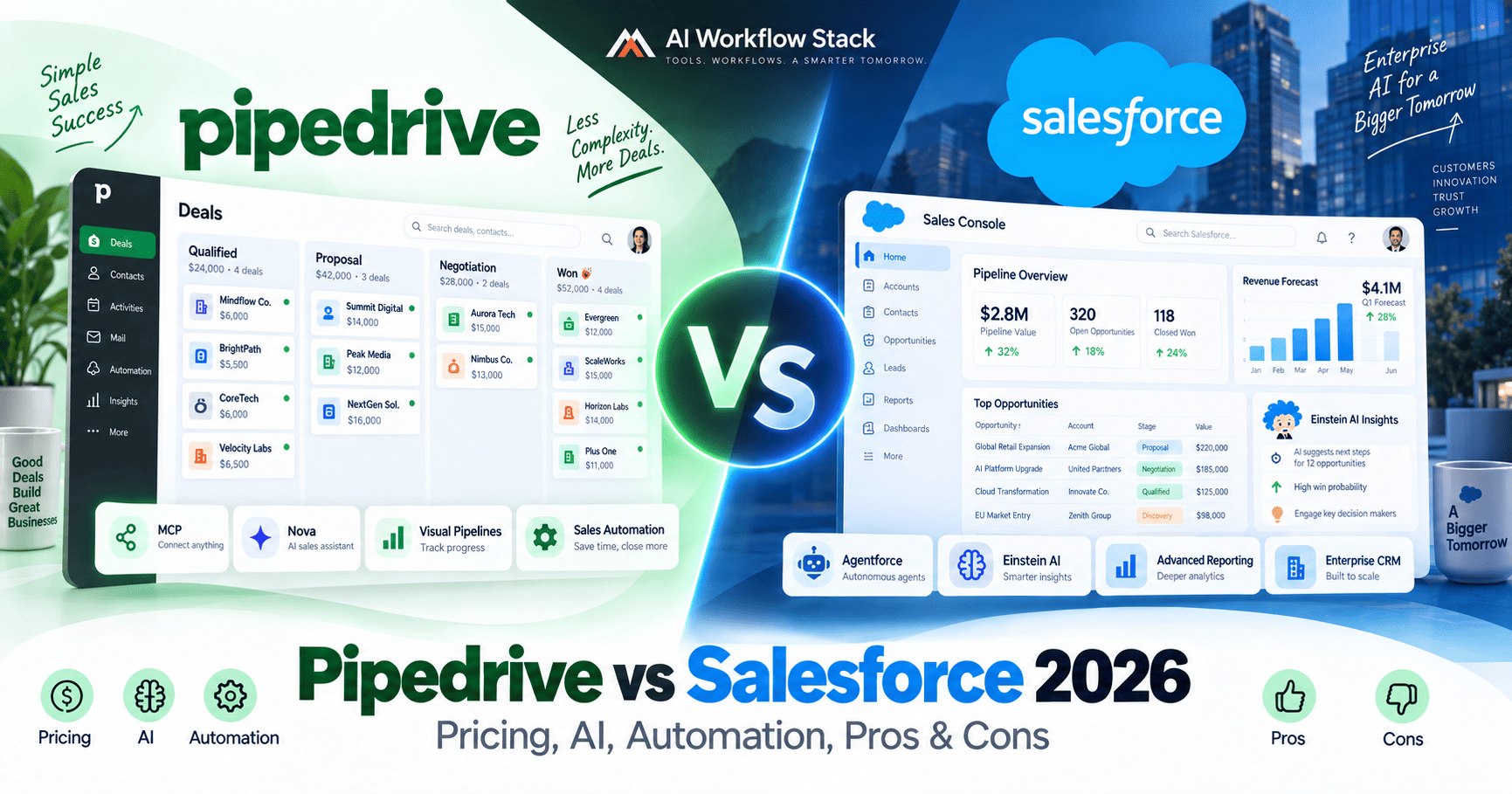
Pipedrive and Salesforce are both established CRM platforms, but they are designed for very different levels of sales complexity. Pipedrive focuses on visual pipeline management, fast adoption, practical automation, AI assistance, and a streamlined experience for small and mid-sized sales teams. Salesforce offers a much broader enterprise platform with deep customization, governance, forecasting, integrations, analytics, and Agentforce AI.
This Pipedrive vs Salesforce 2026 comparison covers current pricing, AI, automation, pipeline management, customization, integrations, reporting, MCP and agentic workflows, scalability, pros and tradeoffs, and the types of organizations each CRM fits best.
Research note: pricing and feature availability were checked against current official Pipedrive and Salesforce sources in September 2026. Both vendors update packaging, AI access, add-ons, usage limits, and promotions regularly, so verify current terms before purchasing.
Pipedrive vs Salesforce 2026: Quick Comparison
| Area | Pipedrive | Salesforce |
|---|---|---|
| Core approach | Sales-focused CRM with visual pipelines and simpler adoption | Highly configurable CRM and enterprise sales platform |
| Free plan | No permanent free plan; 14-day free trial | Free Suite available |
| Entry paid price | Lite: $14/seat/month billed annually | Starter Suite: $25/user/month |
| AI | Sales Assistant, AI reporting, email AI, Nova meeting intelligence | Agentforce, Einstein, scoring, conversation intelligence, AI agents |
| Automation | Strong no-code sales automation from Growth upward | Deep automation through Flow, Agentforce, APIs, and custom development |
| Customization | Strong for SMB and mid-market sales workflows | Extremely deep for complex enterprise requirements |
| Best fit | SMB and mid-market sales teams prioritizing simplicity and pipeline execution | Organizations needing advanced governance, extensibility, and enterprise scale |
Compare current plans
Ready to compare pricing? Review the latest plan details directly from each provider.
What Is Pipedrive?
Pipedrive is a web-based sales CRM centered on activity-based selling and visual pipeline management. It helps teams manage leads, contacts, deals, activities, email communication, sales automation, forecasting, reporting, documents, and integrations without requiring an enterprise CRM administration layer.
In 2026, Pipedrive has expanded beyond traditional pipeline management with AI-assisted reporting, generative email tools, an AI Sales Assistant, the native Pipedrive MCP server, and Nova meeting intelligence. These additions push Pipedrive toward a more active sales workspace while keeping the product focused on frontline sales teams.
For a deeper breakdown, read our Pipedrive Review 2026.
What Is Salesforce?
Salesforce is a cloud CRM and enterprise platform for sales, service, marketing, data, analytics, automation, revenue operations, collaboration, and AI. Its sales offering is still widely known as Sales Cloud, while Salesforce increasingly uses the Agentforce Sales name across current product experiences.
Salesforce can handle basic lead and opportunity management, but its defining strength is the ability to support highly customized processes, complex permission models, multiple business units, advanced forecasting, custom development, global deployments, data governance, and large integration environments.
See our Salesforce Sales Cloud Review 2026 for a full review.
Pipedrive vs Salesforce Pricing
The pricing structures are very different. Pipedrive currently offers four core plans and positions its product around predictable per-seat pricing. Salesforce ranges from a free entry suite to substantially more expensive enterprise packages with optional AI and specialized add-ons.
| Platform / Plan | Published price reference | Billing note |
|---|---|---|
| Pipedrive Lite | $14/seat/month | Billed annually |
| Pipedrive Growth | $39/seat/month | Billed annually |
| Pipedrive Premium | $59/seat/month | Billed annually |
| Pipedrive Ultimate | $79/seat/month | Billed annually |
| Salesforce Free Suite | $0/user/month | Entry-level suite |
| Salesforce Starter Suite | $25/user/month | Billed monthly or annually |
| Salesforce Pro Suite | $100/user/month | Billed annually |
| Salesforce Core | $195/user/month | Billed annually |
| Salesforce Advanced | $395/user/month | Billed annually |
| Salesforce Max | $550/user/month | Billed annually |
Pricing note: Pipedrive can add optional products, top-ups, and usage extensions, while Salesforce total cost can include implementation, consulting, support, Agentforce usage, specialized products, and integrations. Compare the full configuration your team needs rather than only the headline seat price.
Pipedrive currently offers a 14-day free trial with no credit card required. Salesforce offers Free Suite at $0 alongside paid editions and also provides free trials for eligible sales products.
Pipedrive AI vs Salesforce Agentforce
Pipedrive AI and Sales Assistant
Pipedrive AI includes features such as AI-assisted report creation, AI email creation, AI-powered notifications, marketplace recommendations, and other productivity tools. Some features vary by plan, and several newer AI functions are still rolling out or available in beta to selected users.
The current Sales Assistant can answer questions about CRM data, summarize content, create notes, generate email text, and help users navigate Pipedrive. Pipedrive’s documentation notes that some Sales Assistant capabilities remain in beta and require the relevant beta access to be enabled.
Pipedrive Nova Meeting Intelligence
In September 2026, Pipedrive announced the general availability of Nova, its built-in meeting intelligence tool. Nova can prepare sellers before meetings using CRM context, record and transcribe calls, and draft CRM updates after the meeting for review.
This is a meaningful addition for teams that want meeting intelligence embedded directly in the CRM rather than operating a separate call-recording and transcription product.
Salesforce Agentforce and Einstein
Salesforce’s AI strategy is broader and more enterprise-oriented. Agentforce is designed around AI agents that can support prospecting, research, account work, pipeline management, follow-up, recommendations, CRM actions, and other sales workflows.
Einstein continues to provide predictive and generative capabilities such as lead and opportunity scoring, forecasting, conversation intelligence, summaries, email assistance, and recommendations. Availability depends on the Salesforce edition, add-ons, licenses, and usage credits.
Pipedrive MCP vs Salesforce Extensibility
Pipedrive launched a native Model Context Protocol (MCP) server in 2026, allowing compatible AI assistants to interact with live CRM data while respecting Pipedrive permissions. Supported workflows include searching CRM records, creating and updating records, converting leads into deals, managing activities, and generating pipeline insights.
For AI-first teams, native MCP support can make Pipedrive particularly interesting because it creates a direct bridge between CRM data and AI assistants without requiring every workflow to be built through traditional API calls.
Salesforce takes a broader platform approach through APIs, Flow, Apex, MuleSoft, Agentforce, Data Cloud, AppExchange, and custom applications. This provides more enterprise extensibility, although it can require more configuration and specialized expertise.
Pipeline Management
Pipedrive’s interface is built around visual deal pipelines. Teams can move deals between stages, assign activities, track follow-up, filter opportunities, monitor deal health, and keep the next sales action visible. This simplicity is one of Pipedrive’s strongest characteristics.
Salesforce also provides sophisticated opportunity and pipeline management, but it is designed to support more complex organizational structures. Teams can combine opportunities with custom objects, territories, products, forecasts, permission models, account hierarchies, and customized sales processes.
Sales Automation
Pipedrive Growth and higher plans add stronger workflow automation, email synchronization, sequences, scheduling, forecasting, and other sales productivity tools. Premium adds broader lead generation, routing, scoring, data enrichment, document capabilities, and enhanced customization.
Salesforce uses Flow as a central no-code and low-code automation layer, with support for approvals, assignments, notifications, record-triggered processes, Agentforce actions, APIs, Apex code, and external integrations. It can handle substantially more complex business logic but usually demands more administration.
Both platforms can also connect to external automation systems. See our Zapier review, Make review, and n8n review.
Email and Sales Engagement
Pipedrive Growth adds full email synchronization and tracking, while Premium expands the email experience with AI tools and multiple email accounts. Pipedrive also supports sequences and follow-up automation for structured sales engagement.
Salesforce supports email integration, activity capture, sales engagement capabilities, AI-assisted communication, conversation intelligence, and broader workflows across its sales ecosystem. Some specialized sales engagement features may require higher tiers or additional products.
Reporting and Forecasting
Pipedrive provides visual reports, dashboards, revenue forecasting, performance tracking, and AI-assisted report creation. Its reporting model is well suited to teams that want quick visibility into pipeline movement and sales performance without building a large analytics environment.
Salesforce goes further for organizations that need advanced forecasting, pipeline inspection, territory analysis, custom reporting, enterprise dashboards, and connections to Tableau and broader data products.
Customization
Pipedrive supports custom fields, custom pipelines, activities, visibility controls, permissions, automations, reports, integrations, and configurable workflows. Premium and Ultimate provide stronger customization and administrative controls for larger teams.
Salesforce offers much deeper customization through custom objects, record types, layouts, validation rules, Flow, Apex, Lightning components, permission structures, custom applications, and industry-specific architectures.
Integrations and Ecosystem
Pipedrive advertises more than 500 integrations and supports APIs, marketplace apps, automation platforms, and its native MCP server. This is enough for many SMB and mid-market technology stacks.
Salesforce has a substantially larger enterprise ecosystem through AppExchange, MuleSoft, Slack, Tableau, APIs, consulting partners, developers, and specialized industry solutions. The ecosystem is a major advantage when CRM must become a central enterprise platform.
Ease of Use and Administration
Pipedrive is designed to minimize CRM friction. Its visual pipeline, focused navigation, activity-based workflows, and relatively straightforward settings make it easier for many sales teams to adopt without dedicated CRM administrators.
Salesforce can be easy for basic use, but complexity grows quickly as organizations add custom objects, automation, permissions, integrations, analytics, multiple teams, and AI. Larger deployments commonly benefit from dedicated administrators and formal governance.
Security and Governance
Pipedrive provides permissions, visibility groups, security controls, and stronger account protection on higher plans. Ultimate adds enhanced account-security rules, alerts, sandbox capabilities, and broader support options.
Salesforce offers more extensive enterprise governance, including sophisticated permission models, sharing rules, profiles, permission sets, connected-app controls, audit capabilities, security products, and large-scale administrative tooling.
Pipedrive vs Salesforce for Small Businesses
Pipedrive is often easier to justify for a small sales team that mainly needs a strong pipeline, email tools, automation, reporting, and practical AI without enterprise administration. Its Lite plan starts at $14 per seat/month when billed annually, and the product can scale through Growth, Premium, and Ultimate as needs increase.
Salesforce Starter Suite can still be attractive to a small business that specifically wants the Salesforce ecosystem or expects its CRM requirements to become substantially more complex. Free Suite also provides a no-cost entry point for basic use.
Pipedrive vs Salesforce for Mid-Market and Enterprise Teams
Pipedrive can support sophisticated sales teams, particularly when the organization wants to keep the CRM focused on revenue execution rather than turn it into a broad enterprise application platform.
Salesforce becomes more attractive as requirements expand into complex global operations, multiple business units, extensive custom development, advanced governance, highly specific data models, enterprise analytics, and large integration programs.
When Pipedrive Makes More Sense
- You want a visual, sales-focused CRM that is fast to adopt.
- Your team prioritizes pipeline execution, activities, follow-up, and email workflows.
- You want practical automation without a large CRM administration function.
- You want native MCP support for AI assistants and CRM workflows.
- You want built-in meeting intelligence through Nova.
- You prefer lower published seat pricing than Salesforce’s higher sales editions.
Pipedrive looks like a fit? Check the current plans, included features, and latest pricing directly from Pipedrive.
When Salesforce Makes More Sense
- You need extremely deep customization and enterprise governance.
- You manage complex sales structures, territories, permissions, products, or business units.
- You need broad enterprise integrations and custom applications.
- You plan to invest heavily in Agentforce, Data Cloud, Tableau, Slack, MuleSoft, or other Salesforce products.
- You have dedicated CRM administrators, developers, or implementation resources.
Salesforce looks like a fit? Check the current plans, included features, and latest pricing directly from Salesforce.
Pipedrive vs Salesforce: Pros and Tradeoffs
| Platform | Main advantages | Main tradeoffs |
|---|---|---|
| Pipedrive | Simple visual pipeline, lower entry pricing, strong sales automation, MCP, Nova, practical AI | Less enterprise customization and governance depth than Salesforce |
| Salesforce | Deep customization, enterprise scalability, Agentforce, advanced governance, massive ecosystem | Higher total cost, more complex implementation, greater administrative overhead |
Migration Considerations
Moving between Pipedrive and Salesforce requires more than exporting contacts. Teams should map leads, contacts, organizations/accounts, deals/opportunities, pipelines, stages, activities, custom fields, notes, email history, automations, reports, permissions, integrations, and attachments.
Before migrating, clean duplicate records, document the current sales process, identify which automations still deliver value, test field mappings, and run a limited migration before moving the full production database.
Pipedrive vs Salesforce FAQ
Which is cheaper, Pipedrive or Salesforce?
Pipedrive’s published annual prices are lower across its four current plans, starting at $14/seat/month for Lite and reaching $79 for Ultimate. Salesforce offers a Free Suite, but its paid sales editions start at $25/user/month and increase substantially at higher tiers.
Does Pipedrive have a free plan?
No permanent free plan is currently listed. Pipedrive offers a 14-day free trial with no credit card required.
Does Pipedrive support AI assistants?
Yes. Pipedrive has AI features inside the CRM and a native MCP server that allows compatible AI assistants to work with live CRM data while respecting user permissions. Some newer AI features remain in beta or have plan-specific availability.
What is Pipedrive Nova?
Nova is Pipedrive’s built-in meeting intelligence product. It can prepare users before meetings, record and transcribe calls, and draft CRM updates afterward for review.
Which platform is more customizable?
Salesforce provides substantially deeper customization for complex data models, enterprise automation, governance, custom applications, and large-scale deployments. Pipedrive provides enough customization for many SMB and mid-market sales teams while remaining simpler to operate.
Pipedrive vs Salesforce 2026: Final Takeaway
Pipedrive is particularly well suited to sales teams that want a focused CRM, visual pipeline management, fast adoption, useful automation, AI assistance, MCP connectivity, and lower published pricing. It keeps the core sales workflow relatively simple while adding more intelligence around meetings, reporting, communication, and CRM data.
Salesforce is better suited to organizations that need maximum extensibility, complex governance, advanced sales operations, custom development, enterprise analytics, and a broad business-software ecosystem. Those capabilities come with higher licensing costs and greater implementation complexity.
The practical choice depends on whether your CRM should primarily help a sales team execute efficiently or serve as a deeply customized enterprise platform. Pipedrive emphasizes the first model; Salesforce is built to support the second.
Continue researching: Pipedrive Review 2026 | Salesforce Sales Cloud Review 2026 | Salesforce vs HubSpot 2026 | Zoho CRM vs Salesforce 2026 | HubSpot vs Pipedrive 2026
Check current plans before choosing
Pricing, limits, AI usage, and promotional offers can change. Review the latest plan details before making a purchase decision.
Official resources: Pipedrive pricing | Salesforce sales pricing