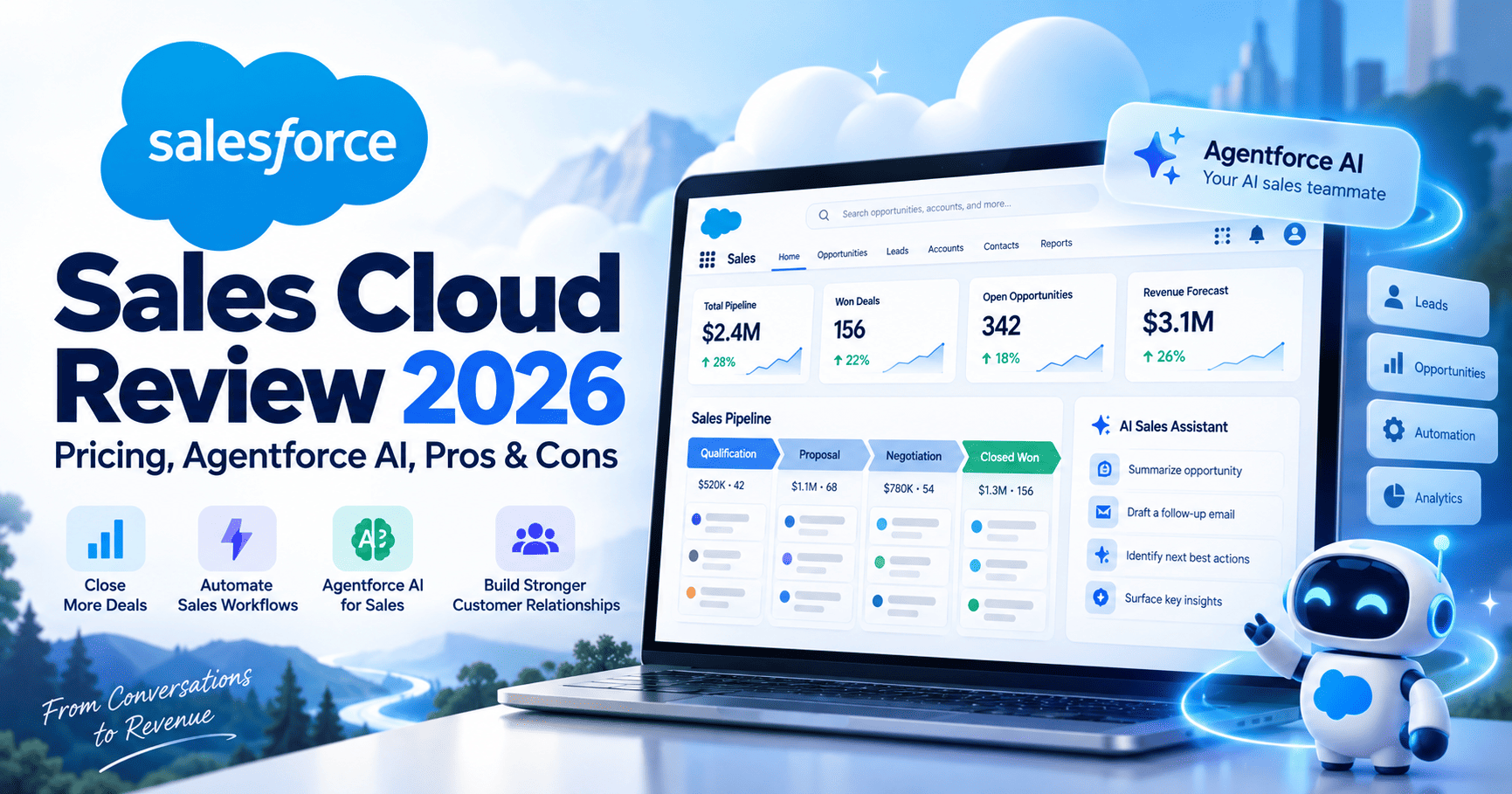
Salesforce Sales Cloud—now increasingly branded as Agentforce Sales—is one of the most established CRM platforms for organizations that need deep sales automation, forecasting, customization, analytics, integrations, and AI at scale. In 2026, Salesforce has pushed further into agentic sales with Agentforce, while continuing to expand AI summaries, conversation intelligence, scoring, workflow automation, and productivity features across its sales products.
This Salesforce Sales Cloud review 2026 covers current pricing, Agentforce AI, core CRM features, automation, analytics, integrations, pros and cons, and the types of teams most likely to benefit from Salesforce.
Research note: this review is based on current Salesforce pricing pages, official help documentation, AppExchange, and 2026 product announcements. Salesforce packaging and AI entitlements change frequently, so verify current pricing, edition requirements, and usage credits before purchasing.
Salesforce Sales Cloud Review 2026: Quick Verdict
Salesforce remains one of the strongest choices for companies that need a highly configurable CRM with advanced forecasting, automation, analytics, governance, and integration options. It is especially well suited to growing and enterprise sales organizations with dedicated CRM administration and complex sales processes.
The tradeoff is complexity and total cost. Salesforce can require more implementation work than simpler CRMs, and advanced AI, data, sales engagement, mapping, revenue, and analytics capabilities may involve higher editions, add-ons, or usage-based costs.
Best for: growing and enterprise sales teams that need deep customization, forecasting, governance, complex workflows, and a broad CRM ecosystem.
Less suitable for: very small teams that prioritize fast setup, simple pipeline management, and predictable total software costs.
Check current plans
Considering Salesforce? Review the latest plans, included features, and current pricing directly from the provider.
What Is Salesforce Sales Cloud?
Salesforce Sales Cloud is a cloud CRM platform for managing leads, accounts, contacts, opportunities, activities, pipelines, forecasts, sales processes, and customer data. Salesforce documentation increasingly refers to Sales Cloud as Agentforce Sales, reflecting the company’s push toward AI-assisted and agentic sales workflows.
At its core, Salesforce gives sales teams a shared system for tracking customer relationships and revenue opportunities. Administrators can extend the platform with custom fields, objects, automation, permissions, reports, dashboards, integrations, and industry-specific processes.
For organizations with broader needs, Salesforce also connects with Service Cloud, Marketing Cloud, Data Cloud, Tableau, Slack, Revenue Cloud, and a large ecosystem of third-party apps.
Salesforce Pricing in 2026
Salesforce currently publishes a broad set of sales editions, ranging from a free entry option to advanced enterprise plans. Current U.S. list pricing is:
| Plan | Current price | Best suited for |
|---|---|---|
| Free Suite | $0/user/month | Very small teams exploring basic CRM capabilities |
| Starter Suite | $25/user/month | Small businesses needing core CRM plus basic sales, service, marketing, and commerce tools |
| Pro Suite | $100/user/month billed annually | Growing teams needing more automation, customization, forecasting, and quoting |
| Core | $195/user/month | Sales organizations needing deeper CRM, AI, Slack, Tableau, and Agentforce-related capabilities |
| Advanced | $395/user/month | Organizations needing broader enterprise sales capabilities and advanced management tools |
| Max | $550/user/month | Large organizations needing the most complete sales stack and highest included capabilities |
Pricing note: Salesforce pricing, included AI capabilities, add-ons, and usage credits can vary by edition and contract. Confirm the current configuration and total cost with Salesforce before purchasing.
Salesforce also publishes separate add-on pricing for products such as Agentforce for Sales, Sales Engagement, Salesforce Maps, Revenue Cloud, Sales Performance Management, and other specialized capabilities.
For current details, see Salesforce’s official sales pricing page.
Does Salesforce Have a Free Plan?
Salesforce now lists a Free Suite at $0 per user/month alongside Starter Suite and higher editions. Salesforce also offers free trials for its sales products, including a 30-day trial with no credit card required for eligible editions.
The free option lowers the entry barrier for very small teams, but organizations needing deeper automation, forecasting, quoting, advanced AI, customization, or enterprise governance will need paid tiers.
Salesforce Core CRM Features
Lead and Opportunity Management
Salesforce supports lead capture, lead conversion, account management, contact management, opportunity tracking, activities, tasks, sales stages, and pipeline management. These records can be customized to reflect different sales motions and business models.
Forecasting and Pipeline Management
Forecasting is a major Salesforce strength. Sales leaders can organize opportunities by stage, owner, team, territory, and forecast category, then use dashboards and reports to track performance against targets.
Higher editions provide deeper forecasting, pipeline inspection, analytics, and management capabilities for larger teams with more complex revenue operations.
Workflow Automation
Salesforce supports workflow automation across records, approvals, assignments, notifications, tasks, and business processes. Administrators can automate repetitive work and connect CRM actions to broader systems.
Salesforce Flow is central to many no-code and low-code automation scenarios, while APIs, Apex, integrations, and external automation tools can support more advanced requirements.
Salesforce Agentforce AI in 2026
AI is now one of the biggest themes in Salesforce’s sales strategy. In 2026, the company expanded Agentforce Sales around the idea of sellers working alongside AI agents that can help with prospecting, account research, lead nurturing, meeting preparation, pipeline management, follow-up, and other repetitive sales tasks.
Salesforce also continues to use Einstein AI across sales workflows for scoring, forecasting, generative summaries, email assistance, conversation intelligence, and recommendations.
Agentforce for Sales
Agentforce for Sales is designed to automate or assist with operational sales work. Depending on edition and add-ons, sales agents can support prospecting, engagement, pipeline management, sales actions, and other CRM tasks.
Salesforce currently lists Agentforce for Sales as a separate add-on in some configurations, and AI sales-agent actions can consume usage credits. Teams should model both license cost and expected AI usage before deploying agents at scale.
AI Summaries and Generative Assistance
Salesforce expanded generative AI access across Free, Starter, and Pro Suite in 2026. Current capabilities include AI-generated summaries, meeting preparation, personalized email assistance, and contextual insights inside CRM records.
Conversation Intelligence
Einstein Conversation Insights can analyze calls and surface topics, follow-up actions, competitor mentions, pricing discussions, sentiment, and other conversation signals. In 2026, Salesforce extended conversation intelligence to Starter and Pro Suite when supported video and meeting providers are connected.
Einstein Scoring and Forecasting
Salesforce continues to offer AI-assisted lead scoring, opportunity scoring, and forecasting in supported editions and licenses. These tools help teams prioritize opportunities and identify patterns in sales data.
Customization and Administration
Customization is one of Salesforce’s defining strengths. Administrators can configure fields, objects, layouts, permissions, validation rules, flows, record types, reports, dashboards, approval processes, and user experiences.
This flexibility is powerful, but it creates administrative overhead. Larger Salesforce environments usually benefit from dedicated ownership, documentation, release management, data governance, and change-control processes.
Salesforce Integrations and AppExchange
Salesforce has one of the largest CRM ecosystems in the market. AppExchange provides apps and integrations across sales, marketing, service, analytics, finance, collaboration, data management, security, and industry-specific workflows.
Businesses can also connect Salesforce through APIs, middleware, MuleSoft, Zapier, Make, n8n, and custom integrations. See our Zapier review, Make review, and n8n review for broader automation options.
Salesforce Pros
- Deep customization: Salesforce can support highly specific sales processes, data models, permissions, and workflows.
- Strong forecasting and analytics: useful for sales leaders managing complex pipelines and revenue targets.
- Large ecosystem: AppExchange, APIs, MuleSoft, Slack, Tableau, and third-party integrations expand the platform significantly.
- Enterprise scalability: Salesforce can support small teams through very large global organizations.
- Expanding AI capabilities: Agentforce, Einstein, conversation intelligence, summaries, scoring, and generative tools continue to grow.
- Strong governance options: higher editions support advanced security, administration, permissions, and enterprise controls.
- Broad platform reach: sales can connect with service, marketing, analytics, data, and revenue operations.
Salesforce Cons
- Can become expensive: per-user pricing, higher editions, add-ons, implementation, and AI usage can increase total cost quickly.
- Implementation complexity: organizations may need administrators, consultants, or developers to get full value from advanced features.
- Feature packaging can be difficult to compare: AI and specialized capabilities may depend on edition, add-ons, credits, or contract terms.
- More CRM than some small teams need: simpler businesses may prefer a lighter product with fewer configuration decisions.
- Ongoing administration is important: without governance, fields, workflows, permissions, and automations can become difficult to manage.
Who Is Salesforce Best For?
- Growing sales organizations that expect their CRM requirements to become more complex over time.
- Mid-market and enterprise teams that need advanced forecasting, permissions, automation, and governance.
- Organizations with complex sales processes that require deep customization.
- Companies using a broad Salesforce ecosystem across sales, service, marketing, analytics, data, and collaboration.
- Teams investing in AI-assisted sales operations through Agentforce and Einstein capabilities.
Salesforce looks like a fit? Compare the current plans and verify which tier matches your team’s requirements.
Who Should Consider an Alternative?
Salesforce may be excessive for a very small team that mainly needs straightforward contact management and a visual pipeline. It may also be less attractive when the priority is keeping implementation simple and total software cost predictable.
Teams that want a simpler sales-first CRM may prefer Pipedrive. Value-focused SMBs that need customization at a lower entry price may prefer Zoho CRM. Organizations that want an easier path into a broad marketing-sales-service platform may also consider HubSpot.
Salesforce vs HubSpot CRM
| Area | Salesforce | HubSpot |
|---|---|---|
| Primary strength | Deep CRM customization, enterprise sales operations, forecasting, ecosystem | Integrated customer platform with easier cross-functional adoption |
| Entry point | Free Suite and Starter Suite from $25/user/month | Free tools plus paid Hubs and customer-platform tiers |
| AI direction | Agentforce, Einstein, sales agents, scoring, conversation intelligence | Breeze Assistant, agents, Smart CRM, cross-Hub AI workflows |
| Customization | Extremely deep | Strong, especially on higher tiers |
| Best fit | Complex and scaling sales organizations | Teams wanting marketing, sales, service, content, and data in one platform |
For more context, read our HubSpot CRM Review 2026.
Salesforce vs Pipedrive
Pipedrive is easier to understand and more focused on visual pipeline management. Salesforce offers much deeper customization, analytics, administration, ecosystem breadth, and enterprise capabilities.
For small and mid-sized sales teams that want a simpler CRM, Pipedrive may be more efficient. For organizations expecting complex processes, multiple teams, advanced permissions, and custom workflows, Salesforce has substantially more headroom. See our Pipedrive Review 2026.
Salesforce vs Zoho CRM
Zoho CRM competes strongly on value and customization for SMBs, while Salesforce provides a deeper enterprise ecosystem and more extensive administration, analytics, and platform capabilities.
Zoho’s lower entry pricing may be more attractive to smaller organizations. Salesforce becomes more compelling when requirements include global scale, complex governance, advanced sales operations, and broad enterprise integrations. Read our Zoho CRM Review 2026.
Ease of Use and Setup
Salesforce can be straightforward for basic lead and opportunity management, but the learning curve rises quickly as teams add automation, custom objects, permissions, dashboards, integrations, AI, and multiple business units.
Smaller teams should start with a limited scope: define the pipeline, required fields, ownership rules, basic reports, and only the automation needed for real business processes. Over-customizing early can make the system harder to maintain.
Security and Governance
Salesforce provides extensive security, permission, audit, and administration controls that become increasingly important in larger deployments. Organizations can manage profiles, permission sets, roles, sharing rules, authentication, connected apps, field visibility, and other governance settings.
Enterprise teams should also document integration ownership, automation changes, deployment processes, backup strategy, access reviews, and AI usage policies.
Salesforce Sales Cloud FAQ
Is Sales Cloud now called Agentforce Sales?
Salesforce documentation now states that Sales Cloud is called Agentforce Sales in many current product and help experiences, although the Sales Cloud name is still widely used.
How much does Salesforce Sales Cloud cost in 2026?
Current published U.S. pricing ranges from Free Suite at $0 to Starter Suite at $25/user/month, Pro Suite at $100, Core at $195, Advanced at $395, and Max at $550 per user/month. Billing terms vary by edition.
Does Salesforce include AI?
Yes. Salesforce sales products include or support a range of AI capabilities through Agentforce and Einstein. Exact features depend on edition, add-ons, licenses, and usage credits.
Does Salesforce have a free trial?
Yes. Salesforce currently advertises a 30-day free trial for its sales products with no credit card required for eligible trials.
Can Salesforce integrate with automation tools?
Yes. Salesforce supports AppExchange integrations, APIs, MuleSoft, and connections with external automation platforms such as Zapier, Make, and n8n.
Is Salesforce Worth It in 2026?
Salesforce is worth considering in 2026 when CRM is a strategic operating platform rather than just a place to store contacts and deals. Its biggest advantages appear when organizations need customization, forecasting, governance, integrations, analytics, and scalable sales operations.
For smaller teams, the key question is whether Salesforce’s flexibility will deliver enough value to justify the additional cost and administration. Free Suite and Starter Suite make entry easier, but advanced workflows and AI can quickly move the total implementation into a different cost category.
Salesforce Sales Cloud Review 2026: Final Takeaway
Salesforce remains one of the deepest and most extensible CRM platforms available. Its 2026 direction is increasingly centered on AI-assisted and agentic selling through Agentforce while maintaining the forecasting, customization, ecosystem, and enterprise administration that have long defined the platform.
For companies that need a CRM capable of supporting complex sales operations and long-term scale, Salesforce remains highly relevant. For teams prioritizing simplicity, lower cost, or faster setup, alternatives such as Pipedrive, Zoho CRM, or HubSpot may be easier to adopt.
Verify pricing before you choose
Pricing, limits, AI usage, and promotional offers can change. Review the latest plan details before making a purchase decision.
Official resources: Salesforce sales pricing | AI Sales Agents | Salesforce AppExchange