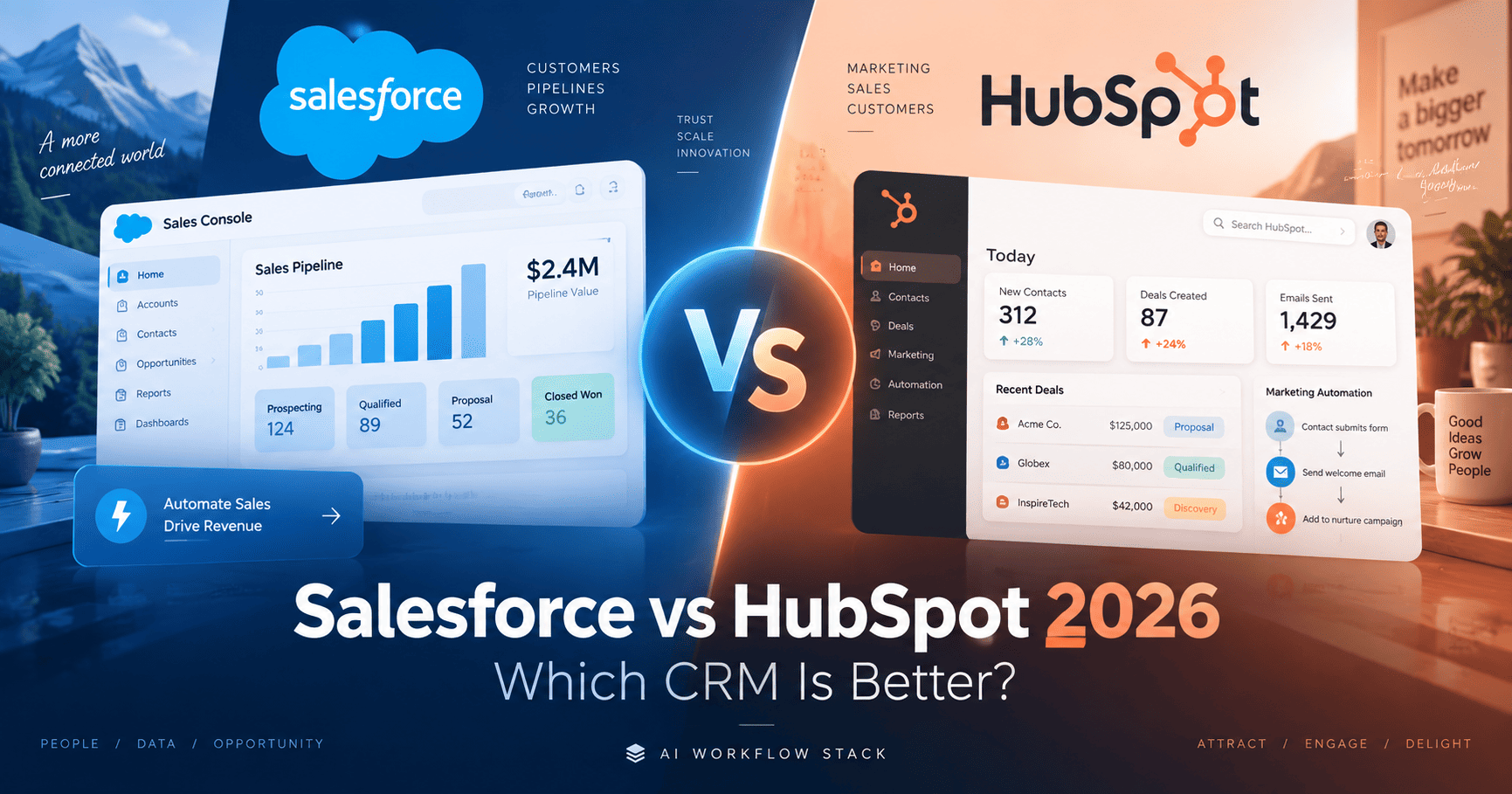
Salesforce and HubSpot are two of the most widely used CRM platforms, but they are built around different operating models. Salesforce emphasizes deep customization, enterprise sales operations, forecasting, governance, and a massive ecosystem. HubSpot emphasizes a more unified customer platform with CRM, sales, marketing, service, content, data, and AI designed to work together with a comparatively simpler adoption path.
This Salesforce vs HubSpot 2026 comparison looks at pricing, CRM capabilities, Agentforce vs Breeze AI, automation, integrations, reporting, ease of use, scalability, and the types of organizations each platform fits best.
Research note: pricing and feature availability were checked against current official Salesforce and HubSpot sources in September 2026. Both companies change packaging, promotions, AI entitlements, and usage credits frequently, so verify the latest details before purchasing.
Salesforce vs HubSpot 2026: Quick Verdict
Choose Salesforce if your organization needs maximum CRM customization, complex sales processes, enterprise-grade governance, advanced forecasting, and a broad integration ecosystem—and can support the implementation and administration those capabilities require.
Choose HubSpot if your priority is faster adoption, a more unified experience across sales, marketing, service, content, and data, and strong automation without the same level of CRM administration. It is generally the more approachable option for SMB and mid-market teams, although advanced tiers can still become expensive.
Bottom line: Salesforce wins on depth, control, and enterprise flexibility; HubSpot wins on ease of adoption, cross-functional simplicity, and a more connected customer-platform experience.
Salesforce vs HubSpot 2026: Quick Comparison
| Area | Salesforce | HubSpot |
|---|---|---|
| Core approach | Highly configurable CRM and enterprise sales platform | Unified customer platform spanning CRM, sales, marketing, service, content, data, and AI |
| Free option | Free Suite available | Free tools for up to 2 users |
| Entry paid sales price | Starter Suite at $25/user/month | Sales Hub Starter standard list price $20/seat/month, with promotional discounts sometimes available |
| AI | Agentforce, Einstein, AI sales agents, scoring, conversation intelligence | Breeze Assistant, Breeze agents, Smart CRM, prospecting and contextual AI |
| Customization | Extremely deep | Strong, especially on Professional and Enterprise |
| Ease of adoption | More complex as requirements grow | Typically simpler for SMB and cross-functional teams |
| Best fit | Complex sales organizations, mid-market, enterprise, highly customized processes | SMBs and growing teams wanting one connected customer platform |
Compare current plans
Ready to compare pricing? Review the latest plan details directly from each provider.
What Is Salesforce?
Salesforce is a cloud CRM and enterprise software platform built around sales, service, marketing, data, analytics, collaboration, automation, and AI. Its sales product is still widely known as Sales Cloud, although Salesforce increasingly uses the Agentforce Sales name in current product experiences.
Salesforce is designed to support everything from basic lead and opportunity management to complex global sales organizations with custom objects, advanced permissions, multiple business units, forecasting, automation, data governance, and extensive integrations.
For a deeper breakdown, see our Salesforce Sales Cloud Review 2026.
What Is HubSpot?
HubSpot is a customer platform built around Smart CRM and connected products for sales, marketing, service, content, data, and revenue operations. Instead of treating CRM as a separate enterprise system, HubSpot emphasizes keeping go-to-market teams on one connected platform.
HubSpot is especially popular with small and mid-sized businesses, but Professional and Enterprise tiers provide advanced automation, analytics, permissions, custom objects, AI, and administrative capabilities for larger organizations.
For a full overview, read our HubSpot CRM Review 2026.
Salesforce vs HubSpot Pricing
Base subscription pricing is only part of the decision. Use our CRM Total Cost Calculator to compare Salesforce and HubSpot total costs across seats, billing, add-ons, setup, migration, and longer-term ownership.
Pricing is one of the biggest differences between the two platforms because Salesforce and HubSpot package their products differently.
| Platform / Plan | Published price reference | Notes |
|---|---|---|
| Salesforce Free Suite | $0/user/month | 2 user licenses included; no contract or credit card required |
| Salesforce Starter Suite | $25/user/month | Billed monthly or annually |
| Salesforce Pro Suite | $100/user/month | Billed annually |
| Salesforce Core | $195/user/month | Billed annually |
| HubSpot Free | $0 | Free for up to 2 users |
| HubSpot Sales Hub Starter | $20/seat/month standard list | Promotional pricing may reduce this for new customers |
| HubSpot Sales Hub Professional | $100/seat/month standard list | One-time onboarding fee applies |
| HubSpot Sales Hub Enterprise | $150/seat/month | One-time onboarding fee applies |
Pricing note: Salesforce and HubSpot both change promotions, AI entitlements, credits, add-ons, and packaging. Compare the full configuration your team needs rather than only the lowest advertised price.
Salesforce Pricing Structure
Salesforce’s sales lineup currently runs from Free Suite through Starter Suite, Pro Suite, Core, Advanced, and Max. Higher tiers progressively add deeper automation, security, AI, data capacity, Slack, Tableau, Agentforce capabilities, and other enterprise tools.
The key budgeting issue is that Salesforce total cost can extend beyond the core license. Organizations may also pay for implementation, consulting, support, specialized clouds, Agentforce usage, integrations, data products, and other add-ons.
HubSpot Pricing Structure
HubSpot Sales Hub currently offers Free, Starter, Professional, and Enterprise tiers. Professional and Enterprise include more advanced automation, sales engagement, analytics, customization, AI, and administration.
HubSpot also sells separate Hubs for marketing, service, content, data, and revenue. That can be an advantage if a company wants one platform across departments, but costs can rise as the organization adds seats, Hubs, credits, and onboarding.
Salesforce Agentforce vs HubSpot Breeze AI
Salesforce Agentforce
Salesforce’s AI strategy centers on Agentforce and Einstein. Agentforce Sales is designed around AI agents that can support prospecting, research, lead nurturing, meeting preparation, pipeline management, follow-up, quoting, and other repetitive sales tasks.
Salesforce Help currently documents Agentforce Sales Management for supported enterprise editions with the required Agentforce add-on or included Agentforce editions. Some sales-agent capabilities are also packaged differently depending on the Salesforce edition.
Einstein continues to support areas such as lead and opportunity scoring, forecasting, conversation intelligence, summaries, email assistance, and recommendations.
HubSpot Breeze AI
HubSpot’s AI layer is built around Breeze Assistant, Breeze agents, and an increasingly context-aware Smart CRM. Breeze Assistant can generate content, summarize CRM records, prepare users for meetings, answer questions, review data, and perform supported tasks across HubSpot.
HubSpot’s September 2026 updates introduced a rebuilt Breeze Assistant, a self-updating CRM, Growth Context, and Context Home. HubSpot also allows users to build custom agents with Breeze Assistant in supported subscriptions.
How the AI Strategies Differ
Salesforce is pushing aggressively toward AI agents inside complex enterprise sales operations, while HubSpot is emphasizing contextual AI across an integrated go-to-market platform. Salesforce offers more enterprise depth and configuration; HubSpot generally presents a more unified user experience across marketing, sales, service, and content.
CRM and Pipeline Management
Both platforms handle leads, contacts, companies/accounts, opportunities/deals, activities, pipeline stages, and sales reporting. The difference is how much complexity they are designed to support.
Salesforce provides much deeper customization for complex sales organizations. Teams can build custom objects, record types, flows, validation rules, permission structures, territory models, and highly specific sales processes.
HubSpot also supports customizable pipelines, fields, automation, and custom objects on higher tiers, but the system is generally easier to configure for teams that do not need an enterprise-level CRM architecture.
Sales Automation
Salesforce and HubSpot both offer significant automation, but Salesforce typically provides more depth for organizations with complex rules and custom processes.
- Salesforce: Flow, assignment rules, approvals, record-triggered automation, custom code, Agentforce, and integrations support advanced business processes.
- HubSpot: workflows, sequences, task automation, lead routing, prospecting tools, AI agents, and cross-Hub automation provide a strong no-code experience.
For teams that also use external automation platforms, both CRMs can connect to broader workflows. See our Zapier review, Make review, and n8n review.
Reporting and Forecasting
Salesforce is particularly strong in complex sales reporting, forecasting, dashboards, pipeline inspection, territory analysis, and enterprise analytics. Tableau and Salesforce’s broader data ecosystem can extend this substantially.
HubSpot provides strong sales reporting and forecasting as well, especially on Professional and Enterprise. Its advantage is that reporting can pull from marketing, sales, service, content, and other customer-platform data without requiring as much integration work between separate products.
Marketing and Customer Service
Both companies extend far beyond CRM, but their architecture and buying experience differ.
HubSpot’s main appeal is that Marketing Hub, Sales Hub, Service Hub, Content Hub, Data Hub, and Revenue Hub are designed around one connected customer platform. This can simplify adoption for teams that want shared customer data across go-to-market functions.
Salesforce also has major products for service, marketing, data, analytics, revenue, and collaboration, but enterprise implementations often involve more configuration, integration, administration, and specialized products.
Integrations and Ecosystem
Salesforce AppExchange is one of the largest business-software ecosystems available, with integrations and apps across sales, service, marketing, finance, analytics, security, data, and industry-specific workflows.
HubSpot also has a large App Marketplace and integrates with common sales, marketing, support, analytics, and productivity software. For many SMBs, HubSpot integrations are easier to activate without extensive CRM administration.
Ease of Use
HubSpot generally has the easier learning curve for small and mid-sized teams. Its free tools and consistent interface allow a business to start with basic CRM and expand gradually.
Salesforce can also be straightforward at a basic level, but its flexibility introduces more configuration decisions. As the implementation grows, organizations often need dedicated CRM administration, governance, documentation, and release management.
Customization and Scalability
Salesforce is one of the strongest choices when deep customization and long-term enterprise scalability are the priority. It can support highly specific data models, permissions, workflows, integrations, and global operations.
HubSpot scales well for many SMB and mid-market organizations and now supports increasingly sophisticated customization. However, companies with extremely complex CRM requirements may still find Salesforce more flexible.
Salesforce vs HubSpot for Small Businesses
Small businesses should focus on setup effort, total cost, and the number of departments that need access—not only the headline license price.
- HubSpot is often easier for a small business that wants CRM, basic sales, marketing, service, and content tools in one place.
- Salesforce Starter Suite can make sense for small businesses that specifically want to enter the Salesforce ecosystem and expect more customization later.
Salesforce vs HubSpot for Growing and Enterprise Teams
For growing teams, HubSpot becomes attractive when the main goal is to keep go-to-market functions aligned around one shared platform with relatively low administrative friction.
Salesforce becomes more attractive when the CRM must support complex sales processes, large user bases, sophisticated permissions, multiple business units, enterprise governance, custom development, and extensive data integration.
When Salesforce Makes More Sense
- You need extremely deep CRM customization.
- You manage complex sales processes, territories, permissions, or business units.
- You expect to build custom enterprise workflows and integrations.
- You want to invest heavily in Agentforce and enterprise AI workflows.
- You already use Salesforce products, Slack, Tableau, MuleSoft, or AppExchange solutions.
Salesforce looks like a fit? Check the current plans, included features, and latest pricing directly from Salesforce.
When HubSpot Makes More Sense
- You want a faster and simpler CRM starting point.
- You want sales, marketing, service, content, and data on one connected platform.
- You prefer strong no-code automation without heavy administration.
- You want a free starting tier for up to two users.
- You want Breeze AI and agents integrated across go-to-market workflows.
HubSpot looks like a fit? Check the current plans, included features, and latest pricing directly from HubSpot.
Salesforce vs HubSpot: Pros and Tradeoffs
| Platform | Main advantages | Main tradeoffs |
|---|---|---|
| Salesforce | Deep customization, enterprise scalability, forecasting, governance, Agentforce, AppExchange | More complex implementation, higher administration burden, total cost can grow quickly |
| HubSpot | Unified customer platform, easier adoption, strong cross-functional automation, Breeze AI, free entry | Advanced tiers can become expensive, less flexible than Salesforce for highly customized enterprise CRM architectures |
Migration Considerations
Moving between Salesforce and HubSpot is not only a data-import project. Teams should evaluate custom fields, object structures, lifecycle stages, pipeline definitions, automation, integrations, permissions, reporting, attribution, activities, and historical data.
Before migrating, clean duplicate records, document the current CRM architecture, identify which workflows are still useful, and test a limited migration before moving the full database.
Salesforce vs HubSpot FAQ
Which is cheaper, Salesforce or HubSpot?
It depends on the configuration. HubSpot offers free tools for up to two users and Sales Hub Starter has a lower standard list price than Salesforce Starter Suite. However, both platforms can become significantly more expensive as teams add advanced tiers, seats, AI usage, onboarding, add-ons, and other products.
Which has better AI, Salesforce or HubSpot?
The platforms emphasize different AI strategies. Salesforce focuses heavily on Agentforce and enterprise AI agents embedded in complex sales operations. HubSpot focuses on Breeze Assistant, agents, and contextual AI across its customer platform. The better fit depends on the workflows and level of CRM complexity required.
Is Salesforce better for enterprise companies?
Salesforce is particularly strong for organizations that require deep customization, large-scale governance, complex permissions, custom development, and extensive integration. HubSpot Enterprise can support sophisticated organizations as well, but the two platforms have different administrative models.
Is HubSpot easier to use than Salesforce?
For many small and mid-sized teams, HubSpot has a simpler initial learning curve. Salesforce provides more configuration depth, which can require more administration as the implementation grows.
Can Salesforce and HubSpot connect to automation tools?
Yes. Both platforms support native integrations, APIs, and external automation tools. Salesforce has AppExchange and MuleSoft, while HubSpot operates a large App Marketplace. Both can also connect to platforms such as Zapier, Make, and n8n.
Salesforce vs HubSpot 2026: Final Recommendation
Salesforce is the stronger fit when CRM customization, enterprise governance, complex sales operations, and long-term extensibility are the main priorities. It offers deeper control over data models, permissions, automation, forecasting, AI agents, and integrations, but usually requires more administration.
HubSpot is the stronger fit when ease of adoption, cross-functional alignment, and a unified customer platform matter more than maximum CRM configurability. It combines sales, marketing, service, content, data, and AI in a more integrated operating model for many SMB and mid-market teams.
The practical decision is to map your expected CRM complexity over the next several years. If your business needs deep customization and enterprise control, Salesforce deserves serious consideration. If you want a connected customer platform with a simpler operational model, HubSpot may be the more efficient path.
Continue researching: Salesforce Sales Cloud Review 2026 | HubSpot CRM Review 2026 | HubSpot vs Pipedrive 2026
Check current plans before choosing
Pricing, limits, AI usage, and promotional offers can change. Review the latest plan details before making a purchase decision.
Official resources: Salesforce sales pricing | HubSpot Sales Hub pricing