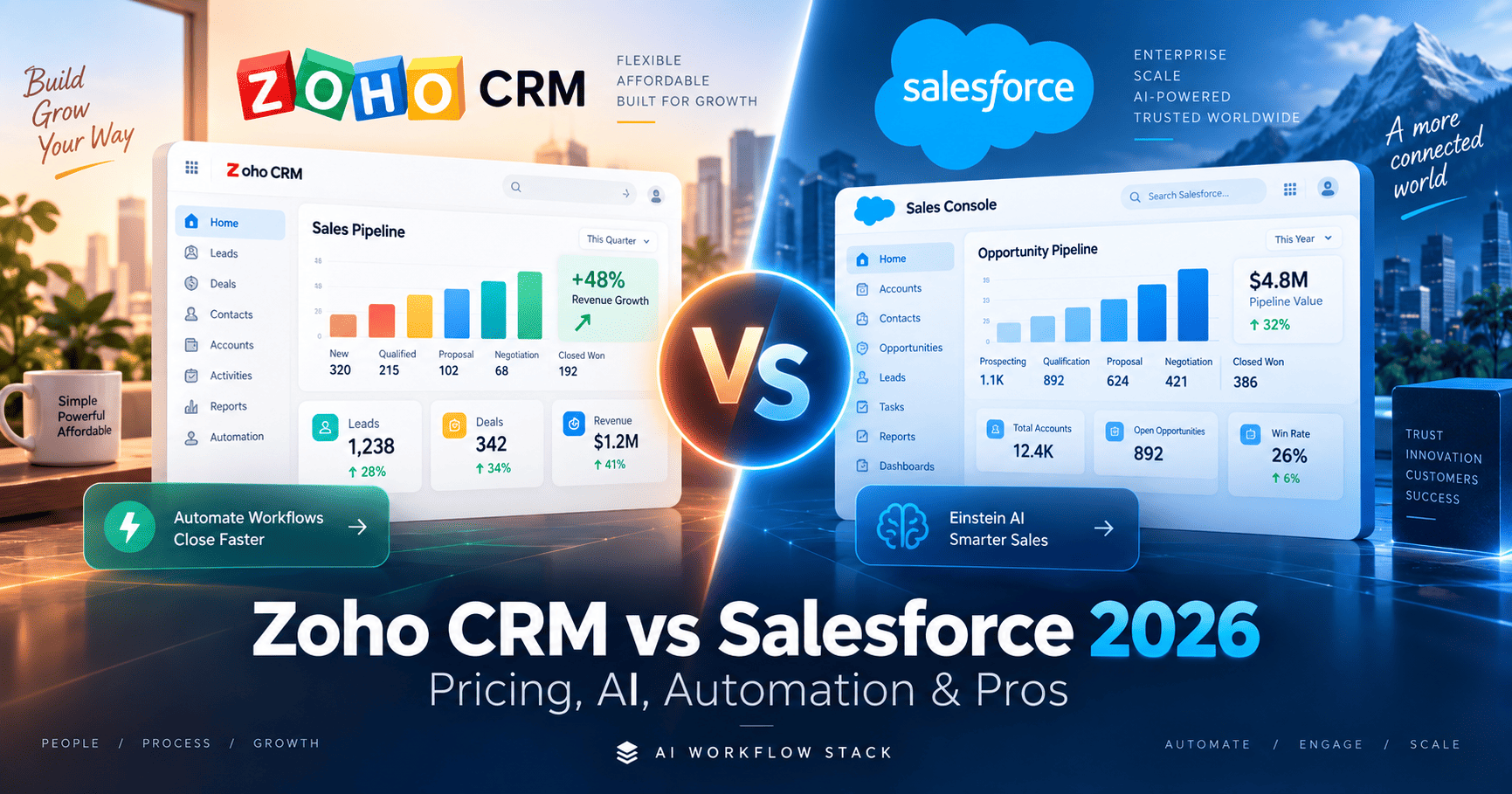
Zoho CRM and Salesforce both offer mature CRM platforms, but they approach the market from very different directions. Zoho CRM focuses on affordability, broad functionality, customization, automation, and a large business-software ecosystem at a comparatively accessible price. Salesforce focuses on maximum extensibility, enterprise governance, advanced sales operations, deep customization, and an enormous app and services ecosystem.
This Zoho CRM vs Salesforce 2026 comparison looks at pricing, AI, automation, customization, integrations, reporting, scalability, ease of use, and the types of organizations each CRM is best suited for.
Research note: pricing and feature availability were checked against official Zoho and Salesforce sources in September 2026. Both vendors update packaging, AI capabilities, usage limits, and add-ons regularly, so confirm current terms before purchasing.
Zoho CRM vs Salesforce 2026: Quick Comparison
| Area | Zoho CRM | Salesforce |
|---|---|---|
| Core approach | Feature-rich CRM with strong value and broad Zoho ecosystem integration | Highly configurable enterprise CRM and sales platform |
| Free option | Free forever for up to 3 users | Free Suite available |
| Entry paid price | Standard: $14/user/month billed annually | Starter Suite: $25/user/month |
| AI | Zia, predictive intelligence, Zia Agents, agentic AI | Agentforce, Einstein, AI sales agents, scoring and conversation intelligence |
| Customization | Strong across paid editions | Extremely deep, especially for enterprise deployments |
| Ease of adoption | Generally easier and less expensive to deploy | More complex as configuration depth increases |
| Best fit | SMBs, value-focused teams, businesses already using Zoho | Mid-market and enterprise organizations with complex sales operations |
Compare current plans
Ready to compare pricing? Review the latest plan details directly from each provider.
What Is Zoho CRM?
Zoho CRM is a sales and customer relationship management platform that covers leads, contacts, accounts, deals, workflows, forecasting, analytics, automation, multichannel communication, customization, AI, and integrations.
One of its biggest advantages is its position inside the broader Zoho ecosystem. Businesses can connect CRM with products such as Zoho Books, Desk, Campaigns, SalesIQ, Analytics, Projects, Forms, and other Zoho applications without building an enterprise-grade integration architecture.
Read our full Zoho CRM Review 2026 for a deeper look at features, Zia AI, pricing, and pros and cons.
What Is Salesforce?
Salesforce is a cloud CRM and enterprise platform for sales, service, marketing, data, analytics, revenue operations, collaboration, automation, and AI. Its sales platform is still widely known as Sales Cloud, although Salesforce increasingly uses the Agentforce Sales branding in current product experiences.
Salesforce can support very simple CRM workflows, but its main strength appears when organizations need custom data models, advanced permissions, complex automation, forecasting, multiple business units, global deployments, deep integrations, and enterprise governance.
For more detail, see our Salesforce Sales Cloud Review 2026.
Zoho CRM vs Salesforce Pricing
Pricing is one of the clearest differences between Zoho CRM and Salesforce. Zoho’s paid CRM editions start significantly lower, while Salesforce prices rise as teams move into more advanced sales, AI, analytics, security, and enterprise capabilities.
| Platform / Plan | Published price reference | Billing note |
|---|---|---|
| Zoho CRM Free | $0 | Free forever for up to 3 users |
| Zoho CRM Standard | $14/user/month | Billed annually; $20/user monthly |
| Zoho CRM Professional | $23/user/month | Billed annually; $35/user monthly |
| Zoho CRM Enterprise | $40/user/month | Billed annually; $50/user monthly |
| Zoho CRM Ultimate | $52/user/month | Billed annually; $65/user monthly |
| Salesforce Free Suite | $0/user/month | Entry-level suite |
| Salesforce Starter Suite | $25/user/month | Billed monthly or annually |
| Salesforce Pro Suite | $100/user/month | Billed annually |
| Salesforce Core | $195/user/month | Billed annually |
| Salesforce Advanced | $395/user/month | Billed annually |
| Salesforce Max | $550/user/month | Billed annually |
Pricing note: Published license prices are only part of total cost. Salesforce add-ons, implementation, consulting, Agentforce usage, support, and integrations can materially increase spend. Zoho can also involve additional products, integrations, and higher editions depending on requirements.
Zoho also offers a 15-day free trial without requiring a credit card, while its free edition supports up to three users. Salesforce offers free trials across its sales products and currently publishes a Free Suite alongside paid tiers.
Zoho Zia AI vs Salesforce Agentforce
Zoho Zia and Zia Agents
Zoho’s AI layer is built around Zia. Zia supports predictive intelligence, recommendations, scoring, anomaly detection, forecasting, data management, customer insights, alerts, and productivity features across CRM.
Zoho has also expanded into agentic AI through Zia Agents. Current Zoho CRM documentation describes AI agents that can execute tasks such as lead qualification, quote creation, coaching, retention support, and other CRM actions. Zoho also supports deploying an agent as a distinct digital employee with its own role, permissions, identity, and audit trail.
Zoho’s current Professional edition page lists AI agents and predictive intelligence among included capabilities, while Enterprise adds broader AI prediction, analysis, governance, and agent-building options.
Salesforce Agentforce and Einstein
Salesforce’s AI strategy centers on Agentforce and Einstein. Agentforce Sales is designed to support sales teams with AI agents that can assist with prospecting, research, pipeline work, record updates, follow-up, recommendations, and other repetitive sales activities.
Salesforce currently prices Agentforce for Sales as a separate $125/user/month add-on for supported enterprise editions in some configurations. Max includes a broader package of AI capabilities and annual Flex Credits, while Core and Advanced can purchase additional AI functionality.
Einstein continues to support predictive and generative capabilities such as lead and opportunity scoring, forecasting, conversation intelligence, email assistance, summaries, and recommendations.
How the AI Approaches Differ
Zoho is bringing agentic AI into a comparatively lower-cost CRM environment, which is attractive for businesses that want automation and AI without immediately entering enterprise-level license pricing. Salesforce offers a broader enterprise AI architecture with deep access to CRM, data, analytics, governance, and the wider Salesforce platform.
Sales Automation
Both platforms support significant automation. Zoho CRM offers workflows, assignment rules, cadences, Blueprint process management, macros, functions, approvals, and AI-powered recommendations depending on edition.
Salesforce uses Flow as a central automation layer and adds assignment rules, approvals, record-triggered processes, custom development, Agentforce, APIs, and broader platform automation. Salesforce usually provides more headroom for extremely complex automation, while Zoho offers strong capabilities at a lower cost.
For cross-platform automation, both can connect with tools such as Zapier, Make, and n8n.
Customization
Zoho CRM provides extensive customization through custom modules, fields, layouts, Canvas, workflows, functions, client scripts, APIs, widgets, portals, and process-management tools. For many SMB and mid-market use cases, this is more than enough flexibility.
Salesforce goes further for organizations that require very complex data models, record types, permissions, custom applications, Apex development, advanced flows, large-scale governance, and industry-specific architectures.
Reporting and Forecasting
Zoho CRM provides reports, dashboards, sales forecasting, analytics, anomaly detection, and predictive intelligence. Zoho Analytics can extend business intelligence across CRM and other business data.
Salesforce provides advanced reports, dashboards, forecasting, pipeline inspection, territory analysis, and enterprise analytics. Core and higher packages also connect more deeply with Tableau capabilities, giving larger organizations a broader analytics stack.
Integrations and Ecosystem
Zoho CRM integrates naturally with the large Zoho application suite and supports third-party apps through its marketplace, APIs, functions, and connectors. Businesses already using Zoho Books, Desk, Campaigns, Analytics, or Zoho One can gain significant value from keeping customer data inside the same ecosystem.
Salesforce has one of the largest CRM ecosystems in the industry. AppExchange, MuleSoft, Slack, Tableau, APIs, consulting partners, developers, and industry-specific solutions make Salesforce particularly strong for complex enterprise integration strategies.
Ease of Use and Administration
Zoho CRM generally has a lower operational barrier for small and mid-sized organizations. It still requires thoughtful configuration, but teams can deploy pipelines, automations, reports, and customizations without necessarily building a dedicated CRM administration function.
Salesforce can be simple at the beginning, but sophisticated deployments often need dedicated administrators, governance, documentation, release management, integration ownership, and sometimes outside implementation partners.
Security and Governance
Both platforms provide role-based access and administrative controls. Zoho supports roles, profiles, data-sharing rules, audit capabilities, territories, teams, and organization controls across higher editions.
Salesforce has especially deep governance capabilities for large organizations, including complex permission models, sharing rules, profiles, permission sets, authentication options, security tools, audit controls, and enterprise administration.
Zoho CRM vs Salesforce for Small Businesses
Zoho CRM is often the more practical starting point for a small business that needs a capable CRM without a large software budget. The free edition supports three users, and paid tiers add automation, AI, customization, inventory, CPQ, analytics, and process management at relatively low per-user prices.
Salesforce Starter Suite is more accessible than older Salesforce entry points and combines sales, service, marketing, and commerce capabilities. It can make sense for smaller companies that specifically want to enter the Salesforce ecosystem and expect substantial growth in complexity.
Zoho CRM vs Salesforce for Mid-Market and Enterprise Teams
Zoho CRM can support large and sophisticated organizations, particularly when cost efficiency and the broader Zoho ecosystem are priorities. Enterprise and Ultimate add deeper customization, AI, security, analytics, and administrative capabilities.
Salesforce becomes especially compelling when the CRM must support complex global operations, advanced permissions, multiple teams or business units, extensive custom development, high integration demands, enterprise analytics, and formal governance.
When Zoho CRM Makes More Sense
- You want strong CRM functionality at a lower per-user cost.
- You are a small or mid-sized business that needs automation and customization without enterprise-level overhead.
- You already use Zoho Books, Desk, Campaigns, Analytics, Zoho One, or other Zoho products.
- You want access to Zia AI and agentic capabilities without immediately moving into premium enterprise pricing.
- You prefer a simpler implementation and administration model.
Zoho CRM looks like a fit? Check the current plans, included features, and latest pricing directly from Zoho CRM.
When Salesforce Makes More Sense
- You need extremely deep CRM customization and governance.
- You operate complex sales processes across multiple teams, regions, or business units.
- You need extensive enterprise integrations or custom application development.
- You plan to invest heavily in Agentforce, Salesforce Data, Tableau, Slack, MuleSoft, or other Salesforce products.
- You have dedicated CRM administrators, developers, or implementation resources.
Salesforce looks like a fit? Check the current plans, included features, and latest pricing directly from Salesforce.
Zoho CRM vs Salesforce: Pros and Tradeoffs
| Platform | Main advantages | Main tradeoffs |
|---|---|---|
| Zoho CRM | Lower pricing, strong automation, Zia AI, broad Zoho ecosystem, flexible customization | Smaller enterprise ecosystem, fewer specialized enterprise implementation resources than Salesforce |
| Salesforce | Maximum customization, enterprise scalability, governance, Agentforce, AppExchange and large partner ecosystem | Higher total cost, more administrative complexity, advanced AI and add-ons can be expensive |
Migration Considerations
Switching between Zoho CRM and Salesforce requires more than moving contacts and deals. Teams should inventory custom fields, modules or objects, pipelines, automations, reports, permissions, integrations, email history, activities, attachments, data quality rules, and historical records.
Before migrating, clean duplicate records, document the existing CRM architecture, identify which automations are still needed, map source fields to destination objects, and test a limited migration before moving the full database.
Zoho CRM vs Salesforce FAQ
Which is cheaper, Zoho CRM or Salesforce?
Zoho CRM has substantially lower published per-user pricing across its standalone CRM editions. Its Standard edition starts at $14/user/month billed annually, while Salesforce Starter Suite starts at $25/user/month and higher Salesforce editions rise to $100, $195, $395, and $550 per user/month.
Does Zoho CRM have a free plan?
Yes. Zoho CRM offers a free-forever edition for up to three users. It includes core CRM capabilities and limited workflow automation.
Which has stronger AI, Zoho or Salesforce?
Both are investing heavily in AI. Zoho combines Zia predictive intelligence with Zia Agents inside a lower-cost CRM environment. Salesforce combines Einstein and Agentforce with a broader enterprise data, analytics, automation, and governance platform. The better fit depends on complexity, budget, and AI deployment requirements.
Can Zoho CRM handle enterprise organizations?
Yes. Zoho CRM Enterprise supports advanced customization, multi-team management, AI, territory structures, granular access controls, and complex sales processes. Salesforce still offers a broader enterprise ecosystem and deeper extensibility for organizations with highly specialized requirements.
Can both CRMs integrate with automation tools?
Yes. Zoho CRM and Salesforce both provide APIs, marketplaces, native integrations, and support for external automation platforms such as Zapier, Make, and n8n.
Zoho CRM vs Salesforce 2026: Final Takeaway
Zoho CRM is particularly attractive for businesses that want strong automation, customization, AI, and reporting while keeping software costs under control. Its combination of lower pricing, a free three-user edition, Zia AI, and the wider Zoho ecosystem makes it a strong option for small and mid-sized organizations.
Salesforce is better suited to organizations that need maximum configurability, enterprise governance, extensive integrations, sophisticated sales operations, and a large implementation ecosystem. The tradeoff is higher cost and greater administrative complexity.
The decision should be based on the level of CRM complexity your organization expects over the next several years. Zoho can deliver substantial capability at a lower total cost, while Salesforce offers more headroom for organizations with demanding enterprise requirements.
Continue researching: Zoho CRM Review 2026 | Salesforce Sales Cloud Review 2026 | Salesforce vs HubSpot 2026 | HubSpot vs Pipedrive 2026
Check current plans before choosing
Pricing, limits, AI usage, and promotional offers can change. Review the latest plan details before making a purchase decision.
Official resources: Zoho CRM pricing | Salesforce sales pricing