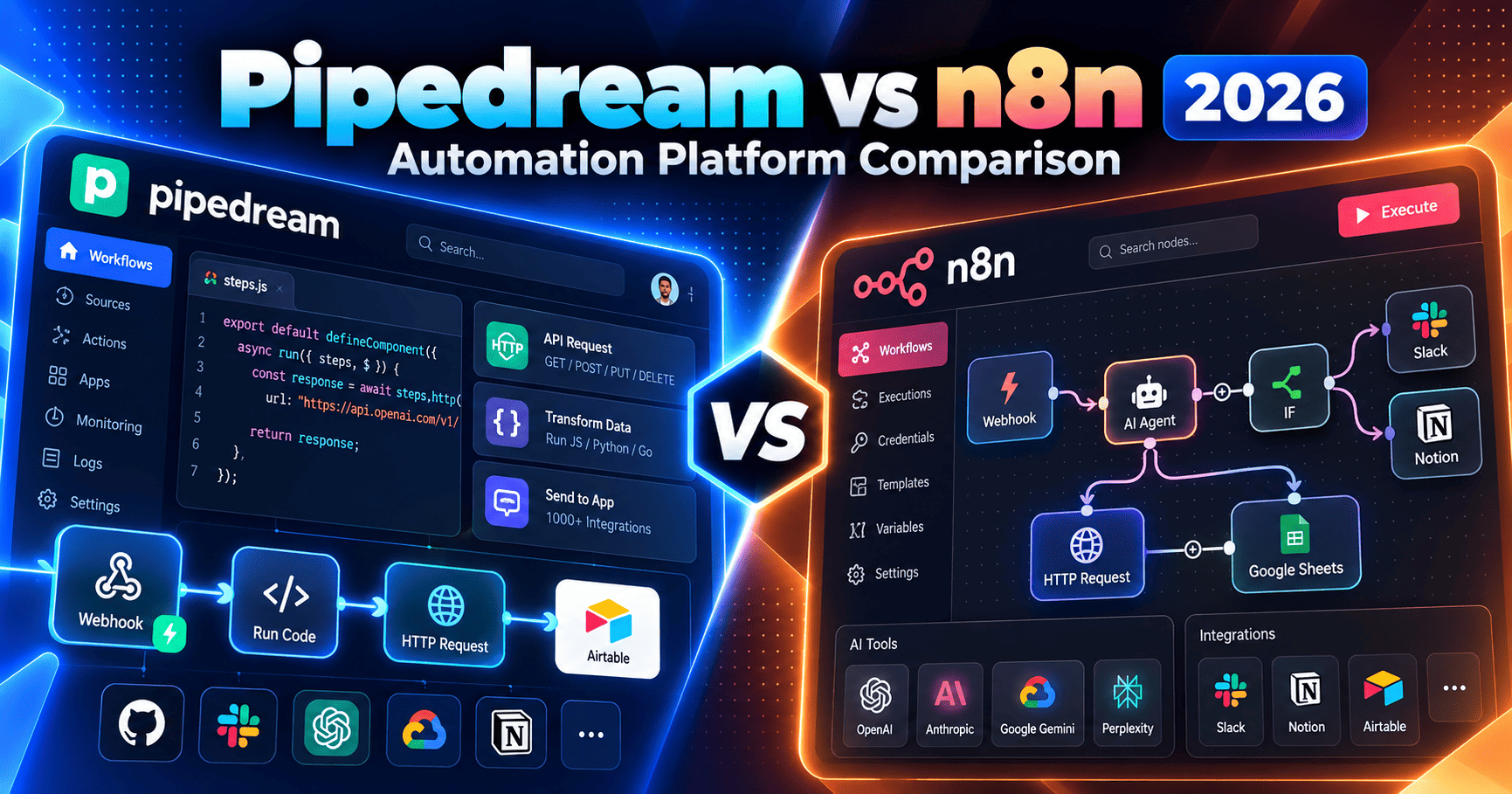
Pipedream and n8n are both powerful automation platforms for technical teams, but they approach workflow building from different directions. Pipedream combines serverless workflows, prebuilt API actions, managed authentication, code execution, MCP, and a developer-first integration layer. n8n combines a visual node-based canvas with APIs, code, AI agents, MCP, self-hosting, and execution-based pricing.
This Pipedream vs n8n 2026 comparison covers pricing models, free access, workflow building, code, integrations, AI automation, MCP, self-hosting, deployment, collaboration, governance, and the tradeoffs that matter most for developers, startups, automation engineers, and technical operations teams.
Research note: pricing models and product capabilities were checked against current official Pipedream and n8n sources in September 2026. Both companies update plan limits, credits, AI products, integrations, and enterprise features frequently, so verify current terms before purchasing.
Pipedream vs n8n 2026: Quick Comparison
| Area | Pipedream | n8n |
|---|---|---|
| Core approach | Developer-first serverless workflows and integration infrastructure | Visual workflow automation and AI orchestration with Cloud and self-hosted deployment |
| Billing model | Compute credits based on workflow segments, runtime, and memory | Complete workflow executions regardless of number of steps |
| Free access | Free plan with a daily credit limit plus free development/testing | 14-day Cloud trial plus self-hosted Community Edition |
| Code | JavaScript, Python, Go and Bash; npm/PyPI-style developer workflow | Code nodes, expressions, HTTP requests, custom/community nodes and API logic |
| Integrations | 2,700+ apps for Workflows; Pipedream MCP/Connect extends to 3,000+ APIs and 10,000+ tools | 1,000+ apps/services plus HTTP/API flexibility and custom/community nodes |
| AI / agents | AI workflow building, MCP, Connect, model/API integrations and agent tooling | AI Agent nodes, model tools, memory, vector stores, human approval, MCP client/server patterns |
| Self-hosting | No general self-hosted Pipedream Workflows deployment | Yes; Community Edition plus paid self-hosted Business/Enterprise |
| Best fit | Developers who want managed infrastructure with deep code and API control | Technical teams that want visual orchestration, AI agents and deployment control |
Compare current plans
Ready to compare pricing? Review current compute credits, execution limits, AI allowances, deployment options, and enterprise features directly from each provider.
What Is Pipedream?
Pipedream is a developer-focused integration and workflow platform for connecting APIs, running serverless automation, executing code, handling authentication, and exposing integrations to applications and AI agents.
Pipedream Workflows supports no-code actions when convenient and custom code when more control is needed. Developers can run JavaScript, Python, Go or Bash inside workflows and connect to thousands of APIs without building every OAuth flow from scratch.
For a broader platform analysis, read our Pipedream Review 2026.
What Is n8n?
n8n is a visual workflow automation and AI orchestration platform aimed at technical teams that want more control than typical no-code tools provide.
Its workflows can combine prebuilt nodes, APIs, webhooks, databases, expressions, custom code, AI models, vector stores, agents, human approvals, sub-workflows and self-hosted infrastructure. Teams can use n8n Cloud or operate their own deployment.
See our n8n Review 2026 for a deeper look at the platform.
Pipedream vs n8n Pricing in 2026
The most important pricing difference is not the headline subscription fee. It is what each platform measures as usage.
| Platform / Plan | Current pricing reference | Usage model / note |
|---|---|---|
| Pipedream Free | $0 | Daily free-credit limit; limited active workflows and connected accounts; development/testing does not consume workflow credits |
| Pipedream paid Workflows | See live pricing page | Platform fee includes a base credit allocation; additional workflow usage is billed according to credits consumed |
| Pipedream Connect | Separate product/pricing | Usage depends on API/tool-call credits plus external users for production embedded integrations |
| n8n Community Edition | No n8n subscription fee | Self-hosted; infrastructure and operational costs remain your responsibility |
| n8n Starter | €20/month billed annually | 2,500 workflow executions; unlimited steps, users, workflows and integrations |
| n8n Pro | €50/month billed annually | 10,000 executions; higher concurrency, projects, AI credits and admin features |
| n8n Business | €667/month billed annually | 40,000 executions; self-hosted; SSO, environments, Git version control and scaling |
| n8n Enterprise | Custom | Cloud or self-hosted; custom execution volume and advanced governance/support |
Pricing note: Pipedream’s documentation directs users to its live pricing page for current paid-plan fees and exact workspace quotas. Pipedream Workflows measures usage in compute credits, while n8n bills Cloud and paid self-hosted plans primarily by complete workflow executions. Taxes, overages, regional pricing and plan packaging can change.
Compute Credits vs Workflow Executions
Pipedream Workflows charges one credit per 30 seconds of compute time at 256MB of memory per workflow segment. Increasing memory increases credit consumption in 256MB increments, and branching or delays can create additional billable workflow segments. Development and test runs in the workflow builder do not consume credits.
n8n uses a simpler execution model: one complete workflow run counts as one execution, regardless of how many steps the workflow contains. That can make the cost model easier to reason about for large multi-step automations.
The tradeoff is architectural. Pipedream’s model reflects actual serverless compute consumption, while n8n’s model focuses on completed workflow runs.
Free Access
Pipedream provides a free plan with a daily credit limit and restrictions on active workflows and connected accounts. Development and testing are free, which is useful for prototyping before deploying production workflows.
n8n Cloud uses a free trial rather than a permanent hosted free tier. However, n8n Community Edition can be self-hosted without an n8n subscription fee for permitted use cases under its license.
Workflow Builder and Developer Experience
Pipedream feels closer to serverless development than a traditional business automation tool. A workflow can start with an app event, HTTP request or schedule, then combine prebuilt actions with custom code and managed credentials.
n8n presents the workflow as a visual graph. Nodes expose inputs and outputs, branches are visible on the canvas, and users can mix visual configuration with code, expressions, APIs and sub-workflows.
Developers who think in functions, events and API calls may find Pipedream especially natural. Teams that want to see complex process logic visually may prefer n8n’s canvas.
Code and Custom Logic
Pipedream has a strong code story. It supports JavaScript, Python, Go and Bash inside workflows and is designed to work comfortably with package ecosystems and API responses.
n8n also supports programmable automation through Code nodes, expressions, HTTP requests, webhooks, custom nodes, community nodes and direct database/API integrations.
Pipedream generally feels more code-native. n8n gives technical teams more of a hybrid visual-programming experience.
Integrations and API Coverage
Pipedream Workflows currently promotes connectivity to more than 2,700 apps and more than 10,000 prebuilt triggers and actions. Its broader Connect and MCP layer reaches more than 3,000 APIs and 10,000+ tools for AI agents and embedded products.
n8n advertises more than 1,000 apps and services. It also relies heavily on HTTP Request, custom nodes, community nodes and API-level flexibility, so the effective integration ceiling is much higher than the native catalog alone suggests.
AI Workflows and Agents
Pipedream is increasingly positioned as integration infrastructure for AI agents. Developers can use managed authentication, API actions, MCP and Connect to give agents access to external software without implementing every integration themselves.
n8n puts agentic behavior directly on its workflow canvas. AI Agent nodes can work with language models, memory, vector stores, tools, APIs, databases and human-in-the-loop approvals as part of larger automation graphs.
Pipedream is particularly compelling when the agent is part of an application or developer stack. n8n is particularly compelling when the agent is one component inside a visual business or technical workflow.
MCP: Pipedream vs n8n
Pipedream offers a hosted MCP server designed to expose thousands of APIs and tools to compatible AI clients. Its developer documentation describes more than 3,000 APIs and 10,000+ tools, along with managed authentication for connected accounts.
n8n supports MCP in both directions. Its MCP Server Trigger can expose n8n tools and workflows to MCP clients, while n8n also provides MCP client functionality for connecting AI workflows to external MCP tools.
The distinction is useful: Pipedream emphasizes a large hosted integration layer for agents, while n8n emphasizes using MCP as part of workflows and self-controlled automation architectures.
Self-Hosting and Deployment Control
Self-hosting is one of n8n’s most important differentiators. Technical teams can deploy Community Edition on their own infrastructure, while Business and Enterprise add paid self-hosted collaboration and governance features.
Pipedream Workflows is a managed serverless platform. That reduces infrastructure work but does not provide the same general self-hosted deployment model as n8n.
Teams with strict infrastructure, data-residency or network requirements may value n8n’s deployment flexibility. Teams that prefer not to operate automation infrastructure may prefer Pipedream’s managed model.
Authentication and Embedded Integrations
Pipedream has a particularly strong offering for software companies that need to embed integrations inside their own apps or AI agents. Pipedream Connect handles user-level authentication and can expose actions, triggers and APIs without requiring teams to build OAuth infrastructure from scratch.
n8n can power backend integrations and also offers enterprise/OEM options for broader embedded use cases, but its standard product is more visibly centered on building and operating workflows.
Collaboration, Security, and Governance
Pipedream provides managed credentials, projects, environment variables and higher-tier controls for technical teams. Its platform also highlights SOC 2 Type II, GDPR and HIPAA-oriented security capabilities.
n8n Pro adds projects and administrative controls, while Business adds SSO, LDAP, environments, Git version control and scaling. Enterprise adds external secrets, log streaming, longer insights history and dedicated support.
Pipedream Pros and Tradeoffs
- Pros: Developer-first workflow model; JavaScript, Python, Go and Bash; managed authentication; broad API coverage; serverless runtime; MCP; Connect for embedded integrations; free development and testing.
- Tradeoffs: Compute-credit pricing requires understanding runtime and memory; no general self-hosted Workflows deployment; visual process mapping is less central than in n8n; production Connect has separate pricing considerations.
n8n Pros and Tradeoffs
- Pros: Visual workflow canvas; execution-based pricing; self-hosting; Community Edition; strong AI Agent tooling; MCP client/server patterns; custom/community nodes; deep API and data control.
- Tradeoffs: Higher learning curve than mainstream no-code tools; self-hosting adds operational responsibility; advanced governance features require higher plans; native integration catalog is smaller than Pipedream’s broader API layer.
Pipedream Is a Strong Fit When…
- Your team thinks in APIs, events, code and serverless functions.
- You want managed authentication without building OAuth flows yourself.
- You need JavaScript, Python, Go or Bash directly inside workflows.
- You are building integrations into an app or AI agent.
- You want a large hosted MCP/API tool layer.
- You prefer managed infrastructure over self-hosting.
Pipedream looks like a fit? Check the latest workflow credit allowances, connected-account limits, MCP/Connect options, and developer features directly from Pipedream.
n8n Is a Strong Fit When…
- You want complex automation represented visually on a canvas.
- You need self-hosting or greater infrastructure control.
- You are building AI agents inside broader multi-step workflows.
- You want predictable execution-based billing for long workflows.
- You need custom nodes, HTTP APIs, databases and technical branching.
- You want MCP to expose or consume tools within your own automation architecture.
n8n looks like a fit? Compare current workflow execution limits, AI credits, Cloud plans, self-hosted options, and enterprise governance directly from n8n.
Pipedream vs n8n for Developers
Pipedream is especially developer-oriented because code, packages, API events and managed authentication are first-class parts of the product. It can feel like a hosted integration runtime rather than a conventional automation app.
n8n is also highly developer-friendly, but its biggest advantage is bridging visual orchestration and technical implementation. Developers can expose complex logic to less technical teammates without hiding the underlying workflow structure.
Pipedream vs n8n for AI Agents
Pipedream is compelling when the goal is giving an AI application or agent authenticated access to thousands of external services through MCP or Connect.
n8n is compelling when an AI agent needs to participate in a broader orchestration that includes databases, APIs, deterministic steps, approvals, branches, schedules and self-hosted systems.
Pipedream vs n8n for Startups
Pipedream can reduce engineering time for startups that need to connect APIs quickly without maintaining integration infrastructure. Free development/testing also makes early prototyping attractive.
n8n can be attractive when a startup wants a visual automation layer it can self-host, or when workflow execution pricing is easier to forecast than compute-based credits.
Alternatives to Pipedream and n8n
If neither platform is the right fit, compare n8n vs Zapier 2026, n8n vs Make 2026, or Make vs Zapier 2026. You can also read our Zapier Review 2026 and Make Review 2026.
Pipedream vs n8n 2026 FAQ
Which is cheaper, Pipedream or n8n?
It depends on workload shape. Pipedream charges Workflows based on compute credits influenced by runtime, memory and workflow segments. n8n paid plans primarily count complete workflow executions regardless of step count. A short compute-light Pipedream workflow and a long multi-step n8n workflow therefore behave very differently from a billing perspective.
Does Pipedream have a free plan?
Yes. Pipedream offers a free plan with a daily credit limit and restrictions on active workflows and connected accounts. Development and workflow testing do not consume workflow credits.
Can I self-host n8n?
Yes. n8n provides a self-hosted Community Edition, while Business and Enterprise add paid self-hosted collaboration, governance and scaling features.
Can I self-host Pipedream Workflows?
Pipedream Workflows is primarily a managed serverless service and does not offer the same general self-hosted deployment model as n8n.
Which has better code support?
Pipedream is more explicitly code-native, with JavaScript, Python, Go and Bash available inside workflows. n8n also supports code and APIs extensively, but places that capability inside a more visual node-based orchestration model.
Do Pipedream and n8n support MCP?
Yes. Pipedream provides a hosted MCP layer with thousands of APIs and tools. n8n can act as an MCP server through its MCP Server Trigger and can also connect AI workflows to external MCP tools.
Which is better for AI agents?
Pipedream is particularly strong when an AI product needs managed access to many external APIs. n8n is particularly strong when agents need to participate in customizable visual workflows with tools, memory, databases, approvals and deployment control.
Pipedream vs n8n 2026: Final Takeaway
Pipedream is particularly well suited to developers building API-heavy workflows, serverless automations, embedded integrations and AI-agent connectivity with managed authentication.
n8n is particularly well suited to technical teams that want visual workflow orchestration, self-hosting, AI agents, MCP, custom logic and more direct control over deployment.
The practical choice comes down to architecture: favor Pipedream when you want managed developer infrastructure and integration APIs; favor n8n when you want a visual automation engine that can run in infrastructure you control.
Check current plans before choosing
Credits, execution limits, AI features, MCP products, deployment options, and enterprise controls can change. Review the latest provider documentation before purchasing.
Continue researching: Pipedream Review 2026 | n8n Review 2026 | n8n vs Zapier 2026 | n8n vs Make 2026 | Make vs Zapier 2026
Official resources: Pipedream pricing documentation | Pipedream Workflows | Pipedream MCP for developers | n8n pricing | n8n integrations | n8n MCP Server Trigger