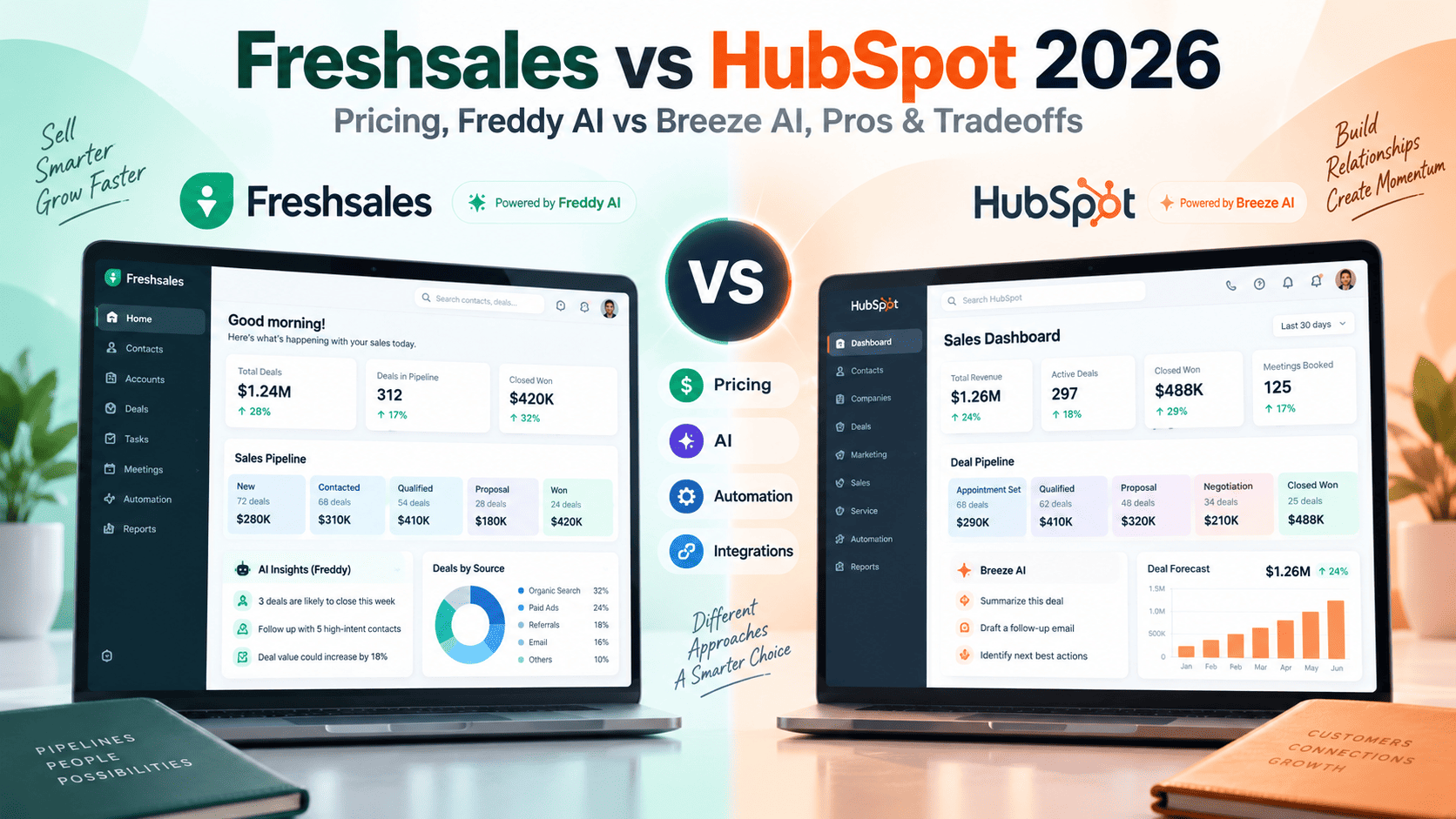
Freshsales and HubSpot are both capable sales CRMs, but they approach the market from different directions. Freshsales focuses on accessible sales CRM functionality, multichannel engagement, automation, and Freddy AI at relatively low published seat prices. HubSpot combines its Smart CRM with Sales Hub, Breeze AI, a broad customer platform, and a much larger app ecosystem.
This Freshsales vs HubSpot 2026 comparison examines pricing, free plans, AI, pipeline management, sales automation, sequences, reporting, customization, integrations, ease of use, scalability, and total cost so you can decide which platform better fits your sales organization.
Research note: pricing, AI packaging, and key product capabilities were checked against current official Freshworks and HubSpot sources in September 2026. Vendors can change pricing, discounts, credits, limits, add-ons, and feature availability, so confirm final terms before purchasing.
Quick Verdict
Choose Freshsales if you want a sales-focused CRM with lower published seat prices, a three-user free plan, and built-in Freddy AI across a relatively straightforward sales workflow. Choose HubSpot if you want CRM to sit inside a broader platform spanning sales, marketing, service, content, data, and automation. The main tradeoff is lower-cost sales focus versus broader platform depth.
Best for: Freshsales → SMB and mid-market sales teams prioritizing value and simplicity
Best for: HubSpot → teams that want one customer platform across multiple departments
Compare your actual 1- and 2-year CRM costs with our CRM Total Cost Calculator →
Freshsales vs HubSpot 2026: Quick Comparison
| Area | Freshsales | HubSpot Sales Hub |
|---|---|---|
| Best fit | SMB and mid-market sales teams that want strong CRM functionality at lower published seat prices | Teams that want sales CRM inside a broader marketing, service, content, data, and revenue platform |
| Free plan | $0 for up to 3 users | $0 for up to 2 users |
| Entry paid plan | Growth: $9/user/month billed annually | Starter: standard reference $20/seat/month; current annual promotional pricing may be lower |
| Mid-tier | Pro: $39/user/month billed annually | Professional: $90/seat/month billed annually |
| Enterprise | $59/user/month billed annually | $150/seat/month |
| AI | Freddy AI scoring, deal insights, recommendations, email assistance, AI Agent | Breeze AI, Prospecting Agent, buyer intent, AI-assisted selling, HubSpot Credits |
| Integrations | Freshworks Marketplace plus native Freshworks ecosystem connections | Very large App Marketplace with 2,000+ apps |
| Implementation profile | Relatively straightforward for sales-focused teams | Can start simply, but advanced Sales Hub and cross-Hub deployments become more complex |
Compare current plans
Ready to compare pricing? Review the latest plan details directly from each provider.
What Is Freshsales?
Freshsales is Freshworks’ sales-focused CRM. It combines contact, account, and deal management with pipelines, email, phone, chat, workflows, sequences, reporting, forecasting, territory management, and Freddy AI.
The product is particularly relevant for small and mid-sized organizations that want a dedicated sales CRM without immediately adopting a larger customer-platform stack. Freshsales also connects to the broader Freshworks ecosystem when a company later needs service, chat, marketing, or additional operational products.
What Is HubSpot Sales Hub?
HubSpot Sales Hub is the sales layer built on HubSpot Smart CRM. It adds prospecting, pipeline management, sequences, sales automation, forecasting, coaching, reporting, and AI-assisted capabilities while sharing customer data with HubSpot’s marketing, service, content, data, and revenue products.
That broader platform model is one of HubSpot’s biggest differentiators. A company can begin with CRM and sales tools, then expand into other Hubs while keeping data and workflows inside the same customer platform.
Freshsales vs HubSpot Pricing in 2026
Before choosing a plan, calculate your CRM total cost for your actual team size, billing cycle, add-ons, setup costs, and 1- and 2-year estimates with our CRM Total Cost Calculator.
| Tier | Freshsales | HubSpot Sales Hub |
|---|---|---|
| Free | $0 for up to 3 users | $0 for up to 2 users |
| Entry paid | Growth: $9/user/month billed annually | Starter: standard reference $20/seat/month; HubSpot currently displays a lower annual promotional rate |
| Professional / Pro | Pro: $39/user/month billed annually | Professional: $90/seat/month billed annually or $100 monthly |
| Enterprise | $59/user/month billed annually | $150/seat/month |
| Required onboarding | No comparable required onboarding fee shown on the standard Freshsales pricing page | $1,500 Professional; $3,500 Enterprise |
| AI usage | Freddy AI Agent: $49 per 100 sessions; paid plans receive 500 one-time complimentary sessions | 500 / 3,000 / 5,000 HubSpot Credits included with Starter / Professional / Enterprise; additional credits are usage-based |
Pricing note: HubSpot’s pricing page currently displays discounted annual Starter pricing alongside its higher standard reference. Because promotional pricing can change, this comparison does not treat that discount as the permanent base price. Professional and Enterprise also carry required onboarding fees. Freshsales prices shown above are its published annual-billing rates.
At published annual seat prices, Freshsales is materially less expensive at the Pro and Enterprise levels. HubSpot can justify a higher total cost for organizations that actively use its wider customer platform, but buyers should compare the full implementation rather than seat price alone.
Free Plan: Freshsales vs HubSpot
Freshsales currently provides a free tier for up to three users. It includes core CRM functionality such as contact, account, and deal management, Kanban views, email templates, dashboards, productivity integrations, and basic customization.
HubSpot’s free Sales tools support up to two users on the current Sales Hub pricing page. The free experience benefits from HubSpot’s broader CRM foundation and ecosystem, but advanced automation, forecasting, sequences, and many sales-management capabilities require paid tiers.
For a very small sales team that prioritizes the number of free CRM seats, Freshsales currently has the numerical advantage. For a company that expects to grow into HubSpot’s marketing, service, or content tools, HubSpot’s free CRM can still be a useful entry point.
Freddy AI vs Breeze AI
Freshsales uses Freddy AI to support contact scoring, duplicate detection, personalized email creation, deal insights, risk signals, recommendations, and next-best-action guidance. Freddy can analyze CRM and engagement data to help sellers focus on stronger contacts and opportunities.
HubSpot’s Breeze AI layer is broader across the customer platform. For sales teams, HubSpot highlights buyer-intent signals, prospect research, personalized outreach, Prospecting Agent, AI-assisted CRM work, and contextual recommendations powered by customer data.
The difference is partly architectural: Freddy is tightly focused on Freshworks sales and customer workflows, while Breeze increasingly spans HubSpot’s marketing, sales, service, content, and data products.
AI Pricing and Usage Models
Freshworks lists Freddy AI Agent at $49 per 100 sessions. Paid Freshsales plans receive 500 one-time complimentary AI Agent or chatbot sessions for evaluation, after which additional session packs can be purchased.
HubSpot uses HubSpot Credits for a growing set of AI agents and usage-based features. Sales Hub currently includes 500 credits on Starter, 3,000 on Professional, and 5,000 on Enterprise. HubSpot’s pricing page also lists additional credits for purchase and shows that Prospecting Agent consumes credits based on recommended outreach.
Neither model should be evaluated only from the base CRM subscription. Teams planning heavy AI-agent usage should estimate realistic monthly volume before comparing total cost.
Pipeline and Deal Management
Both platforms provide visual deal pipelines, configurable stages, activity tracking, and opportunity management. Freshsales emphasizes Kanban views, lifecycle stages, custom sales activities, deal insights, and territory management as teams move into higher plans.
HubSpot combines deal pipelines with prospecting workspaces, forecasting, automation, playbooks, and deeper connections to marketing and service activity. This gives sales teams more cross-functional context when the company already uses multiple HubSpot Hubs.
Sales Sequences and Prospecting
Freshsales Pro includes sales sequences, which can standardize repeated outreach and follow-up steps. Contact scoring and deal insights can help reps decide which prospects and opportunities deserve attention.
HubSpot Professional includes sequences and a more developed prospecting environment. Breeze Prospecting Agent can research accounts, identify signals, and support personalized outreach, making HubSpot particularly relevant for teams building a larger outbound and inbound prospecting operation.
Sales Automation
Freshsales starts with basic workflows in Growth and expands automation capabilities in higher tiers. Its approach is well suited to sales teams that want lead routing, activity automation, sequences, scoring, and process consistency without building a highly complex automation architecture.
HubSpot Professional supports substantially more sophisticated sales automation, including customizable workflows that can coordinate CRM data and activity across the platform. Organizations already using Marketing Hub, Service Hub, or Data Hub can build automation that crosses departmental boundaries.
For external workflow automation, either CRM can be extended with tools such as Zapier, Make, or n8n.
Email, Phone, and Multichannel Engagement
Freshsales Growth includes chat, email, and phone capabilities, giving sales teams multiple communication channels directly in the CRM. Freddy can also help draft personalized prospecting emails.
HubSpot combines email tracking, templates, meetings, calling capabilities, sales engagement, and conversation history with customer data from the wider platform. Organizations using HubSpot for marketing can benefit from a shared view of lead acquisition, engagement, and sales activity.
Reporting and Forecasting
Freshsales includes dashboards and analytics, while Pro and Enterprise add stronger sales intelligence. Enterprise specifically lists forecasting insights, and Freddy can surface deal risk and next-best-action recommendations.
HubSpot Professional and Enterprise provide more advanced sales reporting, forecasting, and management capabilities. For organizations that need sales analytics connected with marketing, service, or revenue data, the unified HubSpot platform can be a significant advantage.
Customization and Governance
Freshsales supports custom fields and configurable sales processes, with Enterprise adding custom modules, field-level permissions, sandbox environments, and audit logs. That combination can satisfy many mid-market governance requirements without moving to a heavier CRM.
HubSpot also becomes more configurable as organizations move into Professional and Enterprise. Its strength is the ability to connect customized CRM processes with the rest of the HubSpot customer platform. Companies requiring even deeper enterprise configuration may also compare Salesforce Sales Cloud or Zoho CRM.
Integrations and App Ecosystem
Freshsales connects with productivity, communication, reporting, and business applications through the Freshworks Marketplace and native Freshworks ecosystem. For companies already invested in Freshdesk, Freshchat, or other Freshworks products, that ecosystem can be operationally convenient.
HubSpot has the broader third-party ecosystem. Its App Marketplace currently contains more than 2,000 apps, covering categories such as communications, ecommerce, analytics, productivity, advertising, automation, accounting, and data management.
If integration breadth is a primary buying criterion, HubSpot has the stronger marketplace footprint. Freshsales remains practical when the required integrations already exist or the company prefers the Freshworks stack.
Ease of Use and Implementation
Freshsales is designed around a relatively focused sales workflow. Teams can begin with contacts, deals, pipelines, communication, and basic automation before adding sequences, territories, AI insights, and governance.
HubSpot is also known for making basic CRM adoption approachable, but the platform can become considerably more complex as a company adds Professional or Enterprise Sales Hub, multiple Hubs, advanced workflows, custom reporting, AI agents, and integrations.
For a sales-only implementation, Freshsales may require fewer platform decisions. For a cross-functional customer platform, HubSpot’s additional complexity can provide broader long-term capability.
Scalability
Freshsales can scale from a three-user free plan into Pro and Enterprise deployments with territories, sequences, custom modules, forecasting, permissions, sandbox testing, and audit logs.
HubSpot scales differently: Sales Hub can grow alongside Marketing Hub, Service Hub, Content Hub, Data Hub, Revenue Hub, and Smart CRM. That makes it especially attractive when CRM is expected to become the shared operational layer for several customer-facing teams.
Freshsales vs HubSpot: Pros and Tradeoffs
| Freshsales | HubSpot |
|---|---|
| Pros: Lower published paid-plan prices; free plan for up to 3 users; Freddy AI; integrated email, phone, and chat; strong sales focus | Pros: Broad customer platform; large integration marketplace; mature sales automation; Breeze AI; strong cross-functional data model |
| Tradeoffs: Smaller external app ecosystem; some advanced features require Pro or Enterprise; AI Agent sessions can add usage cost | Tradeoffs: Higher Professional and Enterprise seat costs; required onboarding fees at those tiers; AI Credits add another usage layer; broader platform can increase complexity |
Freshsales Is a Strong Fit When…
- You want a sales-focused CRM with a lower published price per user.
- Your team needs integrated email, phone, chat, pipelines, workflows, and sequences.
- You value Freddy AI scoring, deal insights, and sales recommendations.
- You are a small team that can use the free plan for up to three users.
- You want mid-market customization and governance without immediately adopting a broader customer platform.
Freshsales looks like a fit? Check the current plans, included features, and latest pricing directly from Freshworks.
HubSpot Is a Strong Fit When…
- You want sales, marketing, service, content, data, and revenue tools built around the same CRM.
- Your organization needs a very large integration ecosystem.
- You want advanced sales automation, prospecting, forecasting, and AI within a broader platform.
- You expect customer data to be shared across multiple departments.
- Your budget can accommodate higher-tier seat pricing and required onboarding costs.
HubSpot looks like a fit? Check the current Sales Hub plans, included features, and latest pricing directly from HubSpot.
Freshsales vs HubSpot for Small Businesses
For a small business primarily focused on sales CRM, Freshsales offers a compelling cost structure. The three-user free tier and $9 Growth plan make it easier to add core CRM functionality without a large software commitment.
HubSpot becomes more attractive when the small business also wants marketing, service, content, or data-management tools from the same vendor. In that scenario, comparing only Sales Hub pricing understates the value of the larger platform.
Freshsales vs HubSpot for Growing and Mid-Market Teams
Freshsales Pro at $39/user/month annually provides contact scoring, deal insights, custom sales activities, territory management, and sequences. That is a strong combination for a growing sales organization watching cost per seat.
HubSpot Professional costs substantially more, but it adds a wider sales-engagement and automation environment plus deeper connections to the rest of HubSpot. Teams should therefore compare operational requirements, not just feature checklists.
How Freshsales Compares With Other CRM Options
If neither platform is an obvious match, the CRM cluster on AI Workflow Stack includes additional comparisons. See Freshsales vs Salesforce, HubSpot vs Pipedrive, HubSpot vs Zoho CRM, Pipedrive vs Zoho CRM, and Salesforce vs HubSpot for different pricing, customization, ecosystem, and automation tradeoffs.
Freshsales vs HubSpot 2026 FAQ
Which is cheaper, Freshsales or HubSpot?
At current published annual rates, Freshsales is less expensive at comparable paid tiers. Growth is $9/user/month, Pro is $39, and Enterprise is $59. HubSpot Professional is $90/seat/month billed annually and Enterprise is $150/seat/month, with required onboarding fees for both tiers.
Does Freshsales have a free plan?
Yes. Freshsales currently offers a free plan for up to three users.
Does HubSpot have a free CRM?
Yes. HubSpot Sales Hub currently lists a free option for up to two users.
What is the difference between Freddy AI and Breeze AI?
Freddy AI focuses on Freshworks workflows such as contact scoring, deal insights, recommendations, email assistance, and AI Agent experiences. Breeze spans HubSpot’s broader customer platform and supports prospecting, buyer intent, content, data, service, and other AI-assisted workflows depending on the product and plan.
Which CRM has more integrations?
HubSpot has the larger third-party marketplace, with more than 2,000 apps currently listed. Freshsales has its own Marketplace and connects particularly well within the Freshworks ecosystem.
Can Freshsales and HubSpot both handle sales sequences?
Yes. Freshsales lists sales sequences in Pro, while HubSpot includes sequences in its more advanced sales offering.
Freshsales vs HubSpot 2026: Final Takeaway
Freshsales and HubSpot solve many of the same core sales-CRM problems, but their strongest use cases are different. Freshsales is particularly compelling for organizations that want a focused sales CRM, Freddy AI, integrated communication, and strong mid-market functionality at comparatively low published seat prices.
HubSpot is better suited to organizations that want sales CRM to sit inside a broader customer platform connecting marketing, service, content, data, revenue operations, AI, and a large app ecosystem. The tradeoff is higher pricing at advanced tiers, required onboarding fees, and a more complex total-cost calculation.
The practical decision therefore depends on scope. If the priority is sales CRM value and a streamlined deployment, Freshsales deserves close consideration. If the priority is a unified customer platform that can extend far beyond sales, HubSpot offers the broader architecture.
Check current plans before choosing
Pricing, limits, AI usage, and promotional offers can change. Review the latest plan details before making a purchase decision.
Official resources: Freshsales pricing | Freddy AI | HubSpot Sales Hub pricing | HubSpot AI for sales