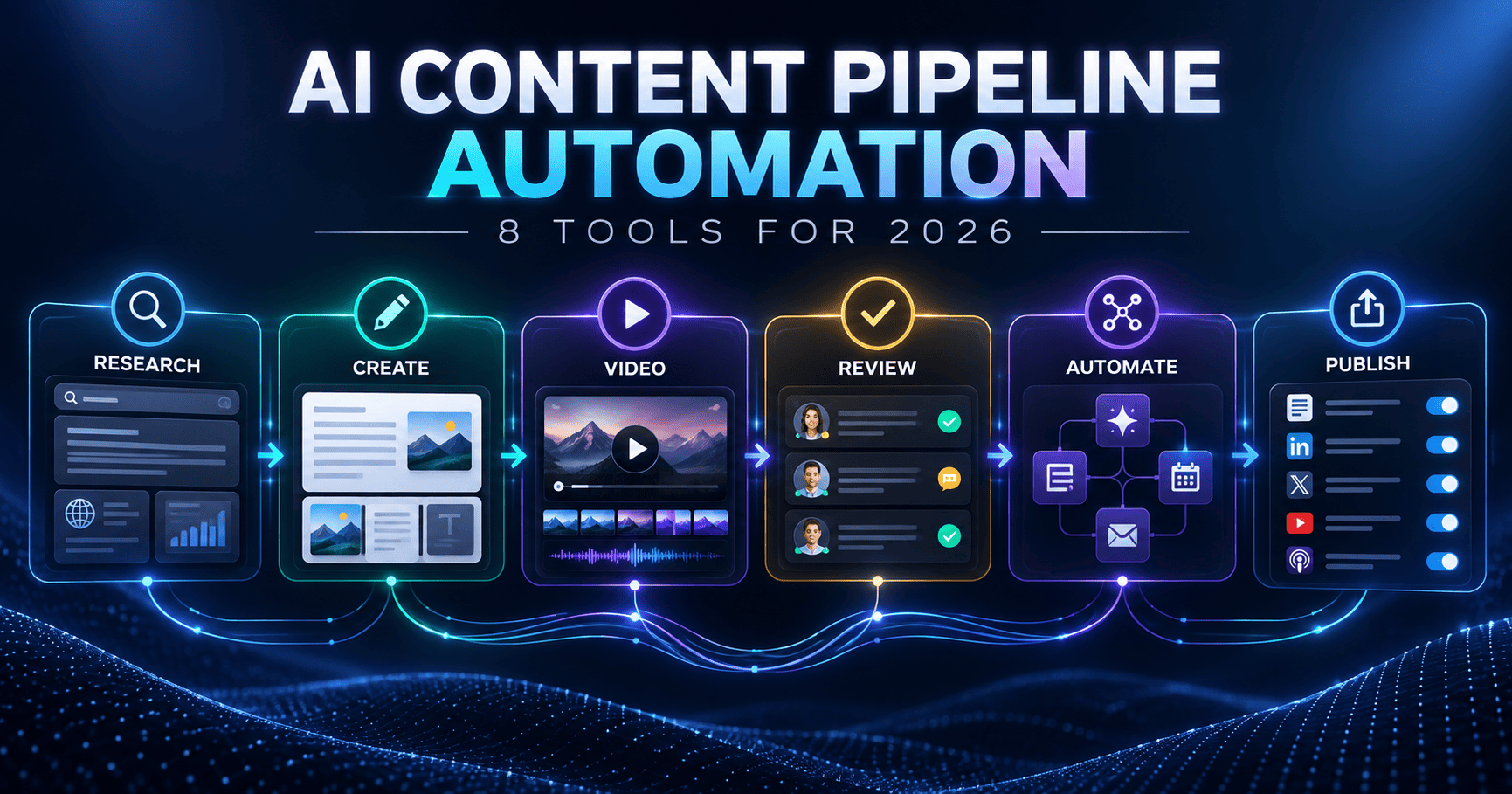
AI content creation is no longer just about generating a blog post, image, or video. The bigger operational challenge is connecting research, briefs, brand context, asset creation, video production, review, localization, approval, publishing, and distribution into a repeatable system.
That is where AI content pipeline automation software becomes useful. Instead of treating every asset as a separate project, these platforms help teams move content from concept to finished output with less manual coordination and fewer handoffs.
This guide compares eight strong options in 2026 for marketing teams, creative operations, video production, and technical content workflows.
If you want a broader overview of individual creation tools, start with our best AI content creation and automation tools guide. This article focuses specifically on pipelines: how content moves from idea to production, review, approval, and distribution.
Editorial note: This comparison is based on official product documentation and vendor materials reviewed in October 2026. We are evaluating workflow capabilities and product positioning rather than claiming controlled hands-on benchmark testing. Features, pricing, limits, and product names can change, so verify current details with each provider before purchasing.
Best AI Content Pipeline Automation Software: Quick Verdict
Best overall for marketing content pipelines: Jasper
Best for enterprise creative production at scale: Adobe Firefly Creative Production
Best for cross-functional visual content: Canva Enterprise
Best for enterprise AI video pipelines: Synthesia
Best for video editing, review, and approvals: Descript
Best for browser-based branded video production: VEED
Best for connecting content tools across SaaS apps: Zapier
Best for technical and customizable pipelines: n8n
Jasper is the strongest fit when the pipeline is primarily marketing-focused and teams want reusable brand context, agents, structured campaign production, and scaled content workflows. Adobe Firefly Creative Production is more specialized for repeatable enterprise creative production. Canva Enterprise is compelling when many teams need to create approved visual content. Synthesia, Descript, and VEED cover different parts of video production, while Zapier and n8n work best as orchestration layers connecting multiple tools.
Quick Comparison
| Tool | Best for | Role in the pipeline | Main tradeoff |
|---|---|---|---|
| Jasper | Marketing content operations | Research → creation → optimization → scaled campaigns | Specialized around marketing |
| Adobe Firefly Creative Production | Enterprise creative production | Batch image/video transformation and reusable workflows | Enterprise-oriented |
| Canva Enterprise | Distributed visual-content teams | Idea → branded creation → collaboration → publishing | Newest AI 2.0 capabilities are still rolling out |
| Synthesia | Scalable AI video | Script/data → video → localization → publishing | Primarily video-focused |
| Descript | Editing and review | Recording → editing → feedback → final media | Not a full marketing orchestration system |
| VEED | Browser-based branded video | Creation → brand control → review → export | Mainly video-centric |
| Zapier | Cross-app orchestration | Connect creation, approval, CMS, and distribution tools | Task costs can rise at scale |
| n8n | Custom technical pipelines | APIs → AI → logic → human review → publishing | Higher learning curve |
What Is AI Content Pipeline Automation?
AI content pipeline automation is the use of AI and workflow software to connect multiple stages of content production into a repeatable system.
A typical pipeline may include:
- Research and topic discovery
- Brief creation
- Brand and audience context
- Text, image, or video generation
- Editing and transformation
- Human review and approvals
- Localization or repurposing
- Publishing or distribution
- Performance reporting
The key difference between a content pipeline and a standalone AI generator is orchestration. A generator produces an asset. A pipeline defines how that asset moves through the organization and what happens before and after generation.
1. Jasper — Best for Marketing Content Pipelines
Jasper has moved well beyond standalone AI writing and now explicitly positions Content Pipelines as structured systems that connect marketing strategy, creative work, and distribution.
Its current pipeline model combines Jasper IQ, Studio, Agents, Grid, and Canvas. Jasper IQ provides reusable brand and audience context, Studio supports custom workflows and automations, Agents execute repeatable marketing tasks, Grid structures high-volume content operations, and Canvas acts as a collaborative creation workspace.
This makes Jasper particularly useful for teams producing:
- Campaign assets
- SEO, AEO, and GEO content
- Product descriptions
- Localization
- Personalized marketing
- Rebrands
- Multi-asset campaigns
The advantage is persistent marketing context. Instead of rebuilding brand, audience, and product information for every prompt, teams can connect that context to repeatable workflows.
Best for: marketing departments, agencies, and content operations teams that need repeatable on-brand production.
Main limitation: Jasper is primarily a marketing-content platform. Teams that need deep video production or broad app-to-app automation will normally need additional tools.
Read our Jasper Review 2026 for a deeper platform analysis.
Explore Jasper Content Pipelines.
2. Adobe Firefly Creative Production — Best for Enterprise Creative Production
Adobe Firefly Creative Production for Enterprise is one of the closest matches to the phrase content pipeline automation itself.
Adobe describes the product as a system for repeatable, governed creative production at scale. Teams can assemble modular workflows, connect inputs and outputs, automate repetitive creative tasks, and run production in batches or through APIs.
Current use cases include:
- Bulk image processing
- Reframing and resizing
- Background changes
- Video transformation
- Localization
- Campaign variants
- Product asset production
- Reusable production workflows
Adobe also provides a Run-Workflow MCP layer that lets compatible AI agents discover and execute Firefly production workflows through natural-language instructions.
For large organizations, this is particularly valuable when one campaign needs dozens or hundreds of variations across markets, products, channels, or formats.
Best for: enterprise creative operations, studios, and organizations producing large volumes of image and video variations.
Main limitation: it is an enterprise-oriented production environment rather than a lightweight tool for individual creators.
Learn about Firefly Creative Production for Enterprise.
3. Canva Enterprise — Best for Concept-to-Campaign Visual Workflows
Canva Enterprise combines AI creation, brand governance, collaboration, approvals, design, and publishing inside one visual-content environment.
Canva AI 2.0 pushes the platform further toward agentic creative workflows. Canva says teams can begin with an idea, brief, or rough concept and use conversational creation to build editable multi-format content while applying brand context.
Its newer workflow layer includes capabilities such as connectors, scheduling, web research, brand intelligence, Sheets AI, and Canva Code 2.0. Canva currently describes AI 2.0 as a research preview, so teams should treat availability and functionality as evolving.
Canva becomes especially useful when the bottleneck is not only asset generation but enabling many non-designers to create approved branded content without depending on a central design team for every variation.
Best for: distributed marketing teams, internal communications, sales enablement, and enterprise visual-content production.
Main limitation: highly specialized production workflows may still need dedicated video, automation, or creative-operations platforms.
4. Synthesia — Best for Enterprise AI Video Pipelines
Synthesia is strongest when the content pipeline is primarily video.
The platform is designed around creating, translating, managing, and publishing AI video at scale. Its enterprise offering includes collaboration and governance features, while its APIs can support programmatic video creation and localization workflows.
Typical use cases include:
- Training and learning content
- Employee onboarding
- Product communications
- Customer education
- Localized video
- Repeatable internal communications
For organizations that repeatedly produce the same type of video across languages or business units, Synthesia can turn video production into a more standardized workflow rather than a one-off studio project.
Best for: organizations producing repeatable training, localization, onboarding, or communications videos.
Main limitation: it is a specialized video platform rather than a complete text-and-design marketing pipeline.
For a direct comparison with another AI video platform, read our Synthesia vs HeyGen 2026.
5. Descript — Best for Content Review and Video Editing
Descript fits an important part of the content pipeline: editing, collaboration, and review.
Its workflow centers on transcript-based audio and video editing. Teams can edit media by editing text, refine recordings, remove filler words, and keep audio and video work inside the same project.
That makes Descript useful when the content bottleneck appears after recording or generation. Instead of repeatedly exporting files between editors and reviewers, teams can keep the project, edits, and feedback closer together.
Best for: podcasts, video teams, social-content operations, editing, review, and approvals.
Main limitation: it is not a complete marketing orchestration system, so broader campaign planning, publishing automation, and cross-app workflows normally require additional software.
Read our Descript Review 2026.
6. VEED — Best for Branded Browser-Based Video Production
VEED is another strong option for teams producing frequent branded video directly in the browser.
Its team and enterprise capabilities combine AI video tools, shared workspaces, brand assets, review workflows, and collaboration. Brand Kits can centralize fonts, colors, logos, images, video, audio, and other reusable elements so multiple creators work from the same approved identity.
VEED is particularly useful when speed and accessibility matter more than building a highly technical production system.
Best for: marketing teams producing social, brand, training, and communications video in a browser-based environment.
Main limitation: broader non-video content pipelines normally require additional automation or marketing systems.
7. Zapier — Best for Connecting the Content Stack
Zapier plays a different role from Jasper, Canva, or Synthesia because it often acts as the orchestration layer between content tools.
Zapier MCP currently exposes more than 9,000 apps and 40,000 actions to compatible AI clients, while traditional Zaps connect triggers and actions across a broad SaaS ecosystem.
A content pipeline could use Zapier to connect:
brief → AI generation → approval database → video tool → storage → CMS → team notification
The advantage is breadth. Instead of requiring every content platform to integrate directly with every other platform, Zapier can coordinate the handoffs.
Best for: marketing and operations teams that want to connect existing content tools without building custom integrations.
Main limitation: complex multi-action pipelines can consume tasks quickly, so high-volume workflows need careful cost planning.
Read our Zapier Review 2026.
8. n8n — Best for Custom and Technical Content Pipelines
n8n is the strongest option in this group when the content pipeline needs more technical control.
Its workflow environment can combine AI agents, language models, memory, vector stores, APIs, webhooks, databases, code, human approval, and external applications inside the same automation.
A technical content pipeline might look like:
research → LLM processing → asset-generation API → human approval → CMS → analytics
Unlike a specialized creative platform, n8n does not define how the content itself must be produced. Instead, it allows teams to orchestrate whichever models, databases, APIs, creative tools, and publishing systems they already use.
Best for: developers, automation specialists, and teams building highly customized content production systems.
Main limitation: the learning curve is higher than tools designed primarily for marketers or creators.
Read our n8n Review 2026.
How to Choose AI Content Pipeline Automation Software
The best AI content pipeline software depends on where content production currently slows down.
If the bottleneck is marketing creation and brand consistency, Jasper is the strongest starting point in this comparison.
If the challenge is producing or transforming large volumes of creative assets, Adobe Firefly Creative Production is more specialized for scalable enterprise production.
Canva Enterprise is compelling when many departments need to create approved visual content while maintaining brand controls.
For video-first workflows, Synthesia, Descript, and VEED solve different parts of the process. Synthesia emphasizes scalable AI video generation and localization, Descript emphasizes editing and review, and VEED emphasizes collaborative branded video production.
Zapier and n8n solve a different problem. Rather than replacing creative tools, they can connect those tools into a broader workflow that moves content between research, generation, review, storage, publishing, and reporting systems.
The practical question is therefore not simply Which tool has the most AI features? It is which stage of your content pipeline creates the most manual work today?
Example AI Content Pipeline
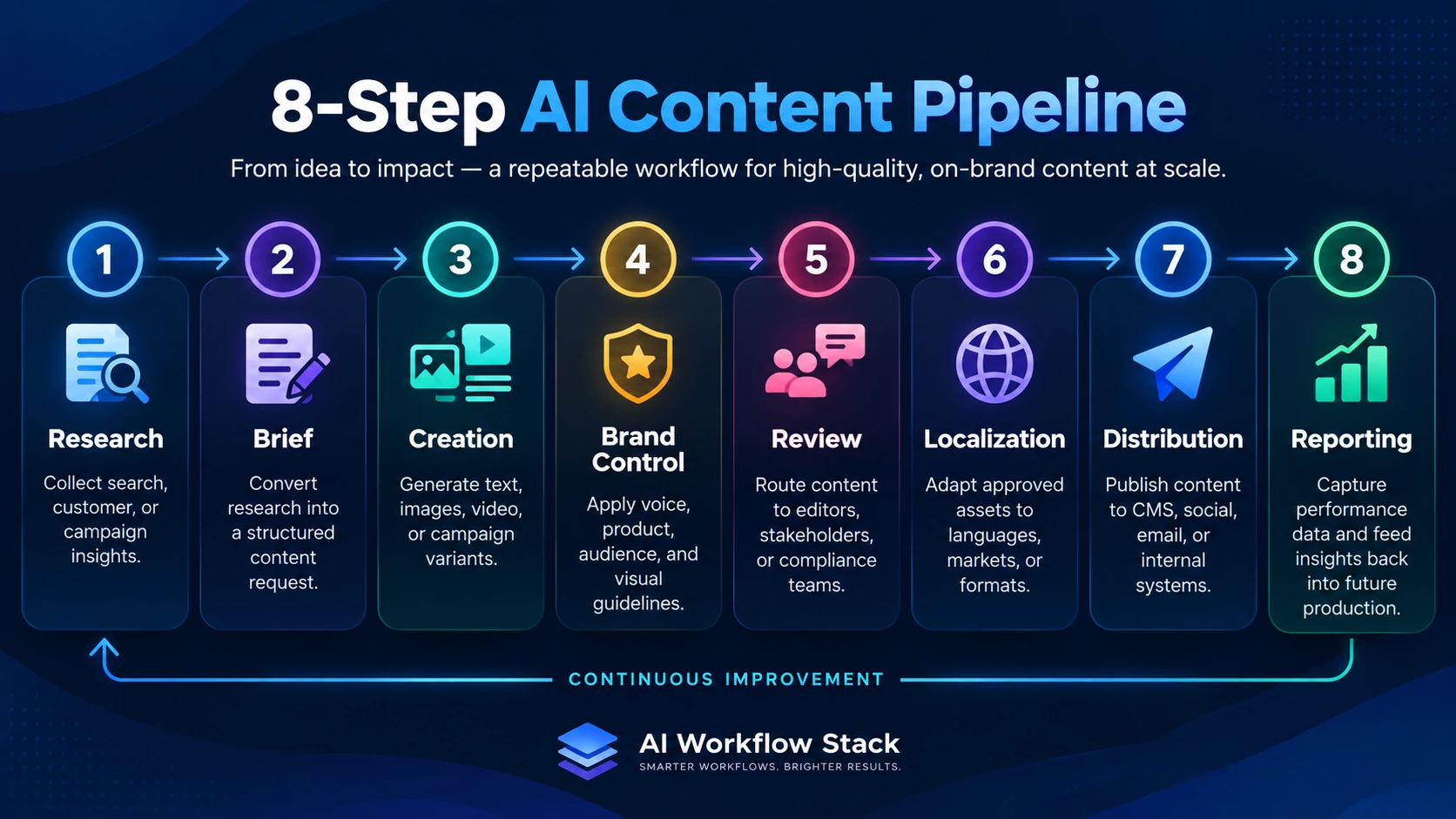
A modern content operation might combine several categories of software instead of trying to make one platform do everything.
- Research: collect search, customer, or campaign insights.
- Brief: convert research into a structured content request.
- Creation: generate text, images, video, or campaign variants.
- Brand control: apply voice, product, audience, and visual guidelines.
- Review: route content to editors, stakeholders, or compliance teams.
- Localization: adapt approved assets to languages, markets, or formats.
- Distribution: publish content to CMS, social, email, or internal systems.
- Reporting: capture performance data and feed insights back into future production.
A specialized creation platform may handle steps 3–5, while Zapier or n8n manages the handoffs between systems.
Frequently Asked Questions
What is the best AI content pipeline automation software?
Jasper is one of the strongest options for marketing-focused content pipelines because it combines reusable brand context, AI agents, structured campaign production, and scalable content workflows. Adobe Firefly Creative Production is stronger for enterprise creative asset processing, while Zapier and n8n are better when the main requirement is connecting multiple tools into one automated pipeline.
What is the best AI content pipeline automation software for enterprise use?
Enterprise teams should choose based on the type of content being produced. Adobe Firefly Creative Production is particularly strong for high-volume image and video workflows, Jasper for governed marketing content operations, Canva Enterprise for distributed branded creation, and Synthesia for scalable AI video and localization.
Which AI content pipeline tools include video creation?
Synthesia, Adobe Firefly Creative Production, Canva, and VEED all support video-related workflows, but in different ways. Synthesia specializes in scalable AI video generation and localization, Adobe focuses on creative production and transformation workflows, while Canva and VEED combine video creation with broader visual-content and collaboration features.
What is the best AI content automation tool for content review and editing?
Descript is particularly well suited to editing and review-heavy audio and video workflows. VEED is also a strong option for browser-based review, brand controls, and collaborative video production.
Can AI automate a content workflow from concept to execution?
Yes, although many organizations will use more than one platform. A pipeline can combine research and generation, creative production, human approval, asset storage, publishing, and analytics. Specialized content platforms can manage creation while Zapier or n8n orchestrates handoffs between systems.
Should I use Zapier or n8n for content automation?
Zapier is generally easier when the goal is connecting mainstream SaaS applications with minimal technical setup. n8n is more attractive when a team needs APIs, custom logic, advanced AI workflows, deeper data handling, or greater control over how the automation runs.
Final Takeaway
The most useful AI content automation systems in 2026 are moving beyond isolated generation.
The emerging model is a connected pipeline where AI assists with research, creation, editing, localization, approvals, transformation, and distribution while brand context and human review remain part of the process.
For many teams, there will not be one platform that replaces everything. A realistic content pipeline may combine a specialized creation platform such as Jasper, Adobe Firefly, Canva, Synthesia, Descript, or VEED with an orchestration system such as Zapier or n8n.
That is why the best platform should be chosen around the workflow bottleneck, not simply which tool generates the most impressive individual asset.
Continue researching: Best AI Content Creation and Automation Tools | Jasper Review | Descript Review | Synthesia vs HeyGen | Zapier Review | n8n Review
Official resources: Jasper Content Pipelines | Adobe Firefly Creative Production | Canva Enterprise | Synthesia Enterprise | VEED Enterprise | Zapier MCP