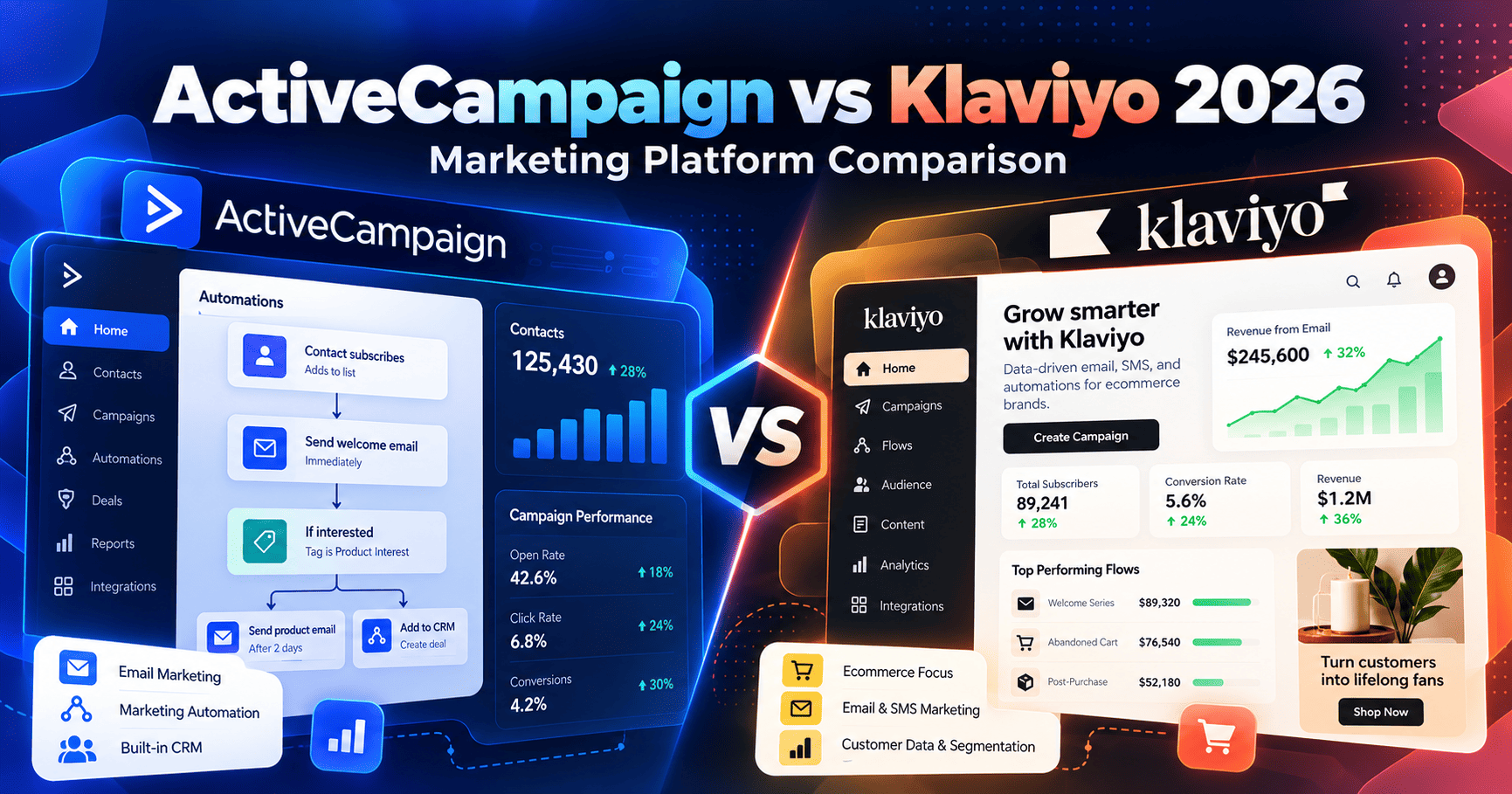
ActiveCampaign and Klaviyo are both powerful marketing automation platforms, but they are built around different operating models. ActiveCampaign emphasizes flexible multi-step automation, email marketing, segmentation, CRM integrations, cross-channel orchestration, and AI-assisted campaign building. Klaviyo is much more deeply centered on B2C and ecommerce marketing, combining customer profiles, behavioral data, email, mobile messaging, revenue attribution, segmentation, and AI in one platform.
This ActiveCampaign vs Klaviyo 2026 comparison covers pricing, free plans, email marketing, SMS and WhatsApp, automation, segmentation, AI, CRM, ecommerce, analytics, integrations, scalability, and the tradeoffs that matter most for online stores and growing marketing teams.
Research note: pricing and product capabilities were checked against current official ActiveCampaign and Klaviyo sources in September 2026. Both vendors update contact tiers, profile limits, AI features, mobile messaging rates, and add-ons frequently, so verify final terms before purchasing.
ActiveCampaign vs Klaviyo 2026: Quick Comparison
| Area | ActiveCampaign | Klaviyo |
|---|---|---|
| Core approach | General-purpose marketing automation with email, cross-channel workflows, CRM connections, AI, and broad business integrations | B2C CRM and ecommerce marketing platform built around profiles, behavioral data, email, mobile messaging, personalization, and revenue attribution |
| Free option | No permanent free plan; 14-day trial | Free plan up to 250 active profiles and 500 emails/month |
| Paid entry point | Starts at $15/month for accounts under 1,000 contacts; pricing scales with contacts and plan | Paid Profiles + Email pricing scales with active profiles and monthly send requirements |
| Automation | Multi-step automations, 950+ recipes, multiple triggers, branching, goals, ecommerce and sales automation | Flows built from real-time customer and ecommerce events, behavioral triggers, segmentation, and channel actions |
| AI | Active Intelligence, AI automation builder, campaign builder, AI-suggested segments, content and image generation | K:AI, Composer, subject-line generation, campaign and flow creation, analysis, segmentation, and Customer Agent |
| CRM | Contact profiles plus optional enhanced CRM add-ons for pipelines and sales engagement | B2C CRM centered on unified customer profiles, marketing, service, analytics, and customer data |
| Ecommerce | Shopify, WooCommerce, Square and premium ecommerce integrations; abandoned cart and product blocks | Deep ecommerce positioning with customer events, purchase behavior, product data, attribution, profiles, and store-centric flows |
| Integrations | 1,000+ integrations plus API, webhooks, Zapier, CRM and ecommerce connections | 350+ apps in Klaviyo’s marketplace plus APIs and strong ecommerce/data integrations |
| Best fit | Businesses that need flexible automation across marketing, sales, services, and multiple business systems | Ecommerce and B2C brands that want customer data, revenue attribution, lifecycle messaging, and personalization tightly connected |
Compare current plans
Ready to compare pricing? Review the latest contact limits, profile-based pricing, automation features, AI tools, and messaging options directly from each provider.
What Is ActiveCampaign?
ActiveCampaign is a marketing automation platform built around email campaigns, automated customer journeys, segmentation, forms, landing pages, CRM integrations, ecommerce workflows, SMS add-ons, analytics, and AI-powered marketing tools.
Its main strength is flexibility. ActiveCampaign can support businesses that are not purely ecommerce-focused and can connect marketing activity to sales pipelines, CRM systems, payments, scheduling, forms, events, advertising platforms, and other business tools.
What Is Klaviyo?
Klaviyo positions itself as a B2C CRM platform rather than only an email service provider. It combines marketing, service, analytics, customer data, AI, email, SMS, WhatsApp, forms, customer profiles, segmentation, and ecommerce-oriented reporting.
The platform is especially strong when purchase history, product interactions, browsing behavior, engagement data, and lifecycle events need to drive highly personalized campaigns and automated flows.
ActiveCampaign vs Klaviyo Pricing in 2026
Both platforms scale pricing with audience size, but they structure billing differently.
| Platform / Plan | Published price reference | Key note |
|---|---|---|
| ActiveCampaign Trial | $0 for 14 days | Trial access; no permanent free tier |
| ActiveCampaign Starter | Starts at $15/month | For accounts under 1,000 contacts; annual billing receives a discount |
| ActiveCampaign Plus / Pro / Enterprise | Contact- and tier-based | Higher plans add unlimited automation actions, stronger segmentation, predictive tools, attribution, support, and governance |
| Klaviyo Free | $0/month | Up to 250 active profiles, 500 emails/month, $5 of mobile messaging and $5 of Composer usage |
| Klaviyo Profiles + Email | Profile-based monthly pricing | Price scales with active profile count and email volume; all plans are billed monthly |
| Klaviyo Mobile Messaging | Separate monthly spend plan | Dollar-based per-message rates vary by channel, country, and number type |
| Klaviyo add-on products | Additional subscriptions | Customer Hub, Helpdesk, Customer Agent, Marketing Analytics, and other products can add cost |
Pricing note: ActiveCampaign prices by plan and contact count, while Klaviyo bases Profiles + Email pricing on active profiles and sending requirements. Klaviyo’s mobile messaging is billed separately using dollar-based per-message rates. Compare the full configuration your business needs rather than only the headline subscription price.
Free Plans and Trials
ActiveCampaign does not currently offer a permanent free plan. Its free trial lasts 14 days and gives users a way to test the platform before upgrading.
Klaviyo offers a permanent Free plan for accounts that remain at or below 250 active profiles and 500 email sends per month. The free tier also includes $5 of mobile messaging usage, $5 of Composer usage, forms, basic templates, built-in reporting, segmentation, and limited support.
Email Marketing
Both platforms provide visual email creation, templates, personalization, scheduling, A/B testing, automation, reporting, and AI-assisted content creation.
ActiveCampaign includes email campaigns and newsletters across its core plans and combines them with automation, conditional content, predictive sending on higher tiers, site tracking, link tracking, and CRM-connected workflows.
Klaviyo connects email more directly to the B2C customer profile. Campaigns and flows can use purchase history, engagement, product interactions, profile attributes, predictive data, and ecommerce events to determine who receives a message and when.
Marketing Automation
Automation is one of ActiveCampaign’s defining strengths. The platform offers more than 950 automation recipes, multiple triggers, branching logic, conditional actions, ecommerce automations, lead and contact updates, goals, sales automation, and cross-channel workflows.
Starter limits automations to five actions per automation, while Plus and above unlock unlimited automation actions. Higher plans also add stronger segmentation, attribution, predictive features, and more advanced orchestration.
Klaviyo uses Flows to automate customer journeys. Flows can be triggered by events such as purchases, abandoned carts, browsing behavior, list joins, profile updates, predicted lifecycle events, and other real-time customer activity.
ActiveCampaign is broader for general business automation. Klaviyo is especially powerful when the automation logic is tightly tied to ecommerce and B2C behavioral data.
Active Intelligence vs Klaviyo K:AI
ActiveCampaign Active Intelligence includes an AI workspace, AI-powered automation builder, campaign builder, campaign follow-up, AI-suggested segments, content generation, image generation, brand kits, suggested actions, and predictive capabilities depending on plan.
ActiveCampaign also offers an AI Prompt Block that can be inserted into an automation to perform tasks such as sentiment analysis, personalization, or data processing during a customer journey.
Klaviyo K:AI spans campaign creation, subject-line generation, data analysis, segmentation, flows, service, personalization, and other customer-data use cases. Klaviyo’s Composer can analyze performance, audit or create campaigns and flows, answer questions from account data, and take actions inside the platform.
SMS, WhatsApp, and Mobile Messaging
ActiveCampaign offers SMS as an add-on and has also expanded into dedicated WhatsApp plans with shared team inboxes, broadcast messaging, automated flows, assignments, and messaging automation.
Klaviyo combines SMS, MMS, WhatsApp, RCS, and other supported mobile channels through its Mobile Messaging product. In 2026, Klaviyo moved mobile messaging from credit-based pricing to dollar-based per-message rates that vary by channel, region, and—in the U.S. and Canada—number type.
Klaviyo’s model is especially relevant for ecommerce teams that want email and mobile messaging to use the same customer profile, segmentation, behavioral events, and revenue reporting.
Segmentation and Personalization
ActiveCampaign segmentation expands by plan from Limited to Standard, Advanced, and Premium. Teams can build segments from contact fields, tags, lists, engagement, site behavior, ecommerce activity, CRM data, and automation outcomes.
Klaviyo segmentation is deeply tied to its unified profile model. Marketers can combine demographic and profile attributes with engagement, purchase behavior, products, recency, frequency, predictive data, browsing, and event history.
For non-ecommerce businesses, ActiveCampaign often provides the more flexible general-purpose segmentation model. For ecommerce and direct-to-consumer brands, Klaviyo’s product and purchase data can create more granular lifecycle targeting.
CRM and Customer Data
ActiveCampaign includes contact profiles, fields, tags, lists, integrations, and customer tracking in its base marketing platform. Traditional pipeline management, deal records, account records, lead scoring, sales engagement, and win probability are now positioned through Enhanced CRM add-ons.
Klaviyo approaches CRM from a B2C perspective. Its customer profile is the center of marketing, service, analytics, and customer data. The platform is designed to unify customer behavior across channels rather than act primarily as a traditional sales pipeline CRM.
Ecommerce
ActiveCampaign supports Shopify, WooCommerce, Square and other ecommerce integrations, with product blocks, abandoned cart, coupons, recurring-payment data, and premium integrations such as Shopify Plus, BigCommerce, and Magento on higher plans.
Klaviyo is more fundamentally ecommerce-first. Customer profiles, automation, product events, purchase history, segmentation, forms, mobile messaging, analytics, attribution, reviews, service, and AI are all designed to work together around B2C lifecycle marketing.
Analytics and Revenue Attribution
ActiveCampaign includes campaign reporting, automation reporting, contact reporting, site and link tracking, custom events, business goals, and attribution/conversion tracking on higher plans. Custom reporting is available as an add-on for some tiers.
Klaviyo’s built-in reporting is strongly oriented toward B2C outcomes. Even the free tier includes campaign performance, customer segmentation, list growth, engagement reporting, and revenue attribution. Additional Marketing Analytics is available as a paid product for deeper analysis.
Integrations and Ecosystem
ActiveCampaign advertises more than 1,000 integrations, including CRM, ecommerce, scheduling, payments, productivity, advertising, and automation tools. It also supports APIs, webhooks, Zapier, and MCP connections to Claude and ChatGPT.
Klaviyo’s app marketplace lists 350+ apps, with a particularly strong ecosystem around ecommerce, loyalty, reviews, subscriptions, shipping, point of sale, customer service, advertising, and data platforms.
Teams that need broader general business connectivity may prefer ActiveCampaign’s wider integration catalog. Ecommerce brands may care more about the depth of Klaviyo’s store, product, and customer-data integrations than the raw number of connectors.
Ease of Use
ActiveCampaign gives marketers substantial automation flexibility, but sophisticated workflows can require more configuration and testing. Active Intelligence is increasingly reducing that setup burden by allowing marketers to describe automation goals in natural language.
Klaviyo can feel intuitive to ecommerce marketers because its core concepts—profiles, segments, campaigns, flows, products, purchases, and revenue—closely match the operating model of an online store. The platform becomes more complex as teams add service, analytics, mobile messaging, and data products.
ActiveCampaign Pros and Tradeoffs
- Pros: Strong general-purpose automation; 950+ recipes; 1,000+ integrations; Active Intelligence; broad CRM and ecommerce connectivity; conditional content; landing pages; flexible workflows beyond ecommerce.
- Tradeoffs: No permanent free plan; pricing rises with contacts and plan level; traditional CRM capabilities increasingly depend on add-ons; SMS, custom reporting, and other capabilities can add cost.
Klaviyo Pros and Tradeoffs
- Pros: Permanent free tier; ecommerce-first customer profiles; strong behavioral segmentation; revenue attribution; email + mobile messaging; K:AI and Composer; strong B2C data and lifecycle workflows.
- Tradeoffs: Profile-based pricing rises with audience growth; mobile messaging is a separate spend plan; advanced analytics, service, Customer Agent, and other products can add cost; less focused on traditional B2B sales CRM workflows.
ActiveCampaign Is a Strong Fit When…
- Your business needs marketing automation beyond ecommerce.
- You want complex multi-step workflows with broad business integrations.
- You connect marketing to scheduling, CRM, sales, payments, events, forms, or professional services.
- You want AI-assisted campaign and automation building.
- You need conditional content, predictive sending, landing pages, and broad segmentation.
- You prefer a platform that can support both B2B and B2C use cases.
ActiveCampaign looks like a fit? Check current contact tiers, automation limits, Active Intelligence access, CRM add-ons, SMS options, and annual pricing directly from ActiveCampaign.
Klaviyo Is a Strong Fit When…
- Your business is primarily ecommerce, retail, or direct-to-consumer.
- You want purchase behavior and product events to drive segmentation and automation.
- You need email, SMS, WhatsApp, forms, customer data, and revenue attribution in one B2C platform.
- You want lifecycle flows around browse abandonment, cart abandonment, post-purchase, win-back, and repeat purchases.
- You value deep ecommerce integrations over the largest possible general app catalog.
- You want a permanent free tier while your audience is still very small.
Klaviyo looks like a fit? Compare active-profile pricing, email limits, mobile messaging, Composer, ecommerce data, and B2C CRM features directly from Klaviyo.
ActiveCampaign vs Klaviyo for Ecommerce
Klaviyo is purpose-built around ecommerce and B2C lifecycle marketing. Its profile model, product events, purchase history, attribution, predictive data, mobile messaging, and flow architecture make it especially well aligned with online stores.
ActiveCampaign remains a strong option when ecommerce is only one part of a broader customer journey that also includes sales pipelines, appointments, services, CRM systems, lead nurturing, or non-store business processes.
ActiveCampaign vs Klaviyo for B2B Marketing
ActiveCampaign is generally more naturally aligned with B2B and service businesses because it supports broader CRM integrations, lead nurturing, account-style workflows, scheduling, business goals, and sales automation through its enhanced CRM options.
Klaviyo can support many B2C subscription and service models, but its product architecture and messaging are much more centered on consumer profiles, commerce events, and direct customer relationships.
ActiveCampaign vs Klaviyo for Growing Marketing Teams
ActiveCampaign can scale from straightforward email automation into more sophisticated cross-channel workflows, stronger segmentation, predictive tools, reporting, CRM integrations, and enterprise governance.
Klaviyo can scale with a growing consumer brand by expanding profile volume and layering in mobile messaging, Customer Hub, Helpdesk, Customer Agent, Marketing Analytics, Reviews, and additional data capabilities.
Alternatives to ActiveCampaign and Klaviyo
If neither platform is the right fit, compare HubSpot Marketing Hub vs Mailchimp 2026. Teams that need flexible workflow automation outside a marketing suite can also compare n8n vs Zapier 2026 or Make vs Zapier 2026.
ActiveCampaign vs Klaviyo 2026 FAQ
Which is cheaper, ActiveCampaign or Klaviyo?
The answer depends on audience size and required features. ActiveCampaign starts at $15 per month for accounts under 1,000 contacts, while Klaviyo offers a permanent Free plan up to 250 active profiles and then moves to profile-based paid pricing. Both become more expensive as audience size and product usage grow.
Does ActiveCampaign have a free plan?
No. ActiveCampaign currently offers a 14-day trial rather than a permanent free plan.
Does Klaviyo have a free plan?
Yes. Klaviyo Free currently supports up to 250 active profiles and 500 email sends per month, plus $5 of mobile messaging usage and $5 of Composer usage.
Which is better for ecommerce?
Klaviyo is more specifically designed around ecommerce and B2C customer data, product behavior, purchases, lifecycle flows, and revenue attribution. ActiveCampaign is more general-purpose and can be attractive when ecommerce must connect to broader CRM, sales, services, scheduling, or business automation.
Which has stronger marketing automation?
ActiveCampaign offers very broad multi-step automation for many business models, while Klaviyo excels at automated flows triggered by consumer behavior and ecommerce events. The stronger fit depends on whether your automation is general business orchestration or commerce-centered lifecycle marketing.
Do both platforms support AI?
Yes. ActiveCampaign uses Active Intelligence for campaign creation, automation building, segmentation, content, images, and optimization. Klaviyo uses K:AI and Composer across campaigns, flows, data analysis, segmentation, support, and other B2C workflows.
Which is better for B2B marketing?
ActiveCampaign is generally more naturally aligned with B2B and service-based marketing because of its broader CRM integrations, lead nurturing, sales workflows, scheduling, business goals, and general-purpose automation model.
ActiveCampaign vs Klaviyo 2026: Final Takeaway
ActiveCampaign is particularly well suited to businesses that want flexible marketing automation across multiple channels, CRMs, sales processes, services, and general business workflows. Its automation depth and broad integration ecosystem make it useful well beyond ecommerce.
Klaviyo is particularly well suited to ecommerce and B2C brands that want customer profiles, purchase behavior, product data, email, mobile messaging, lifecycle flows, AI, and revenue attribution tightly connected in one platform.
The practical choice comes down to business model: choose ActiveCampaign when marketing automation must support many kinds of customer journeys; choose Klaviyo when commerce data and B2C lifecycle marketing are at the center of the strategy.
Check current plans before choosing
Contact tiers, active-profile billing, SMS rates, AI features, add-ons, and annual discounts can change. Review the latest pricing and plan terms before making a purchase decision.
Continue researching: HubSpot Marketing Hub vs Mailchimp 2026 | Jasper vs Copy.ai 2026 | n8n vs Zapier 2026 | Make vs Zapier 2026
Official resources: ActiveCampaign pricing | ActiveCampaign AI marketing | ActiveCampaign plan overview | Klaviyo pricing | Klaviyo billing | Klaviyo mobile messaging pricing