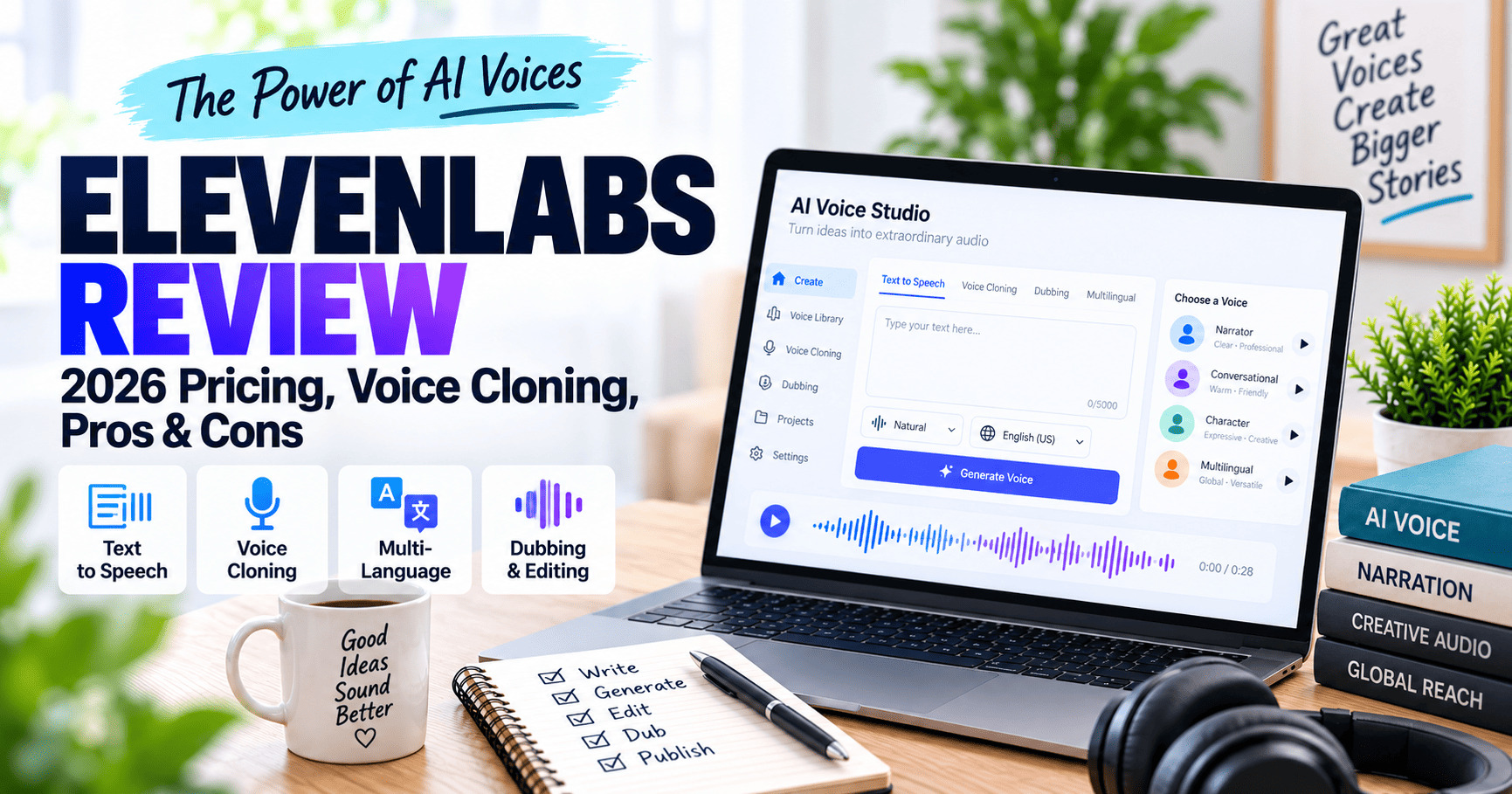
If you need realistic AI narration, voice cloning, multilingual dubbing, sound effects, or speech generation for videos, podcasts, courses, apps, or marketing content, ElevenLabs is one of the most prominent AI audio platforms available in 2026.
What started as a text-to-speech product has expanded into a broader creative audio platform with voice cloning, dubbing, speech-to-text, voice design, sound effects, music, Studio projects, and tools for teams and developers.
This ElevenLabs review examines the platform’s current features, pricing, strengths, limitations, voice-cloning options, and the types of creators and businesses most likely to benefit from it.
If you are comparing multiple AI tools for content production, start with our guide to the best AI content creation and automation tools. If your bigger bottleneck is editing recorded video or podcasts rather than generating voice, see our Descript review.
Editorial note: This review is based on ElevenLabs’ publicly available product pages, pricing information, and documentation reviewed in September 2026. We are not claiming to have conducted controlled hands-on benchmark testing. Features, limits, prices, supported languages, and credit usage can change, so verify current details before subscribing.
ElevenLabs Review: Quick Verdict
ElevenLabs is a strong fit for creators, marketers, educators, publishers, localization teams, and developers who need high-quality AI-generated speech or multilingual voice workflows.
Its biggest strengths are its range of voice options, flexible text-to-speech tools, Instant and Professional Voice Cloning, multilingual dubbing, and a platform that now extends beyond speech generation into transcription, sound effects, music, and creative production.
The main trade-off is that usage is credit-based. Different products draw from the same monthly credit pool, so heavy users need to understand how much each workflow consumes before choosing a plan.
What Is ElevenLabs?
ElevenLabs is an AI audio platform focused on generating, transforming, and localizing spoken content. Its core products include text to speech, voice cloning, dubbing, speech to text, voice changing, sound effects, music, and production tools.
For content creators, the most important capabilities are usually:
- Text-to-speech narration
- Instant Voice Cloning
- Professional Voice Cloning
- Voice Design
- Multilingual dubbing
- Speech-to-text transcription
- Sound effects generation
- Studio projects for longer-form content
Explore ElevenLabs’ current platform.
How ElevenLabs Works
The basic workflow is straightforward: choose or create a voice, enter text, select a speech model, adjust available voice settings, and generate audio.
ElevenLabs also supports cloned voices. A user can create an Instant Voice Clone from a short reference sample, while Professional Voice Cloning is designed for higher-fidelity results from more substantial voice recordings.
The same platform can also translate and dub existing audio or video into additional languages while attempting to preserve speaker identity, timing, tone, and emotional characteristics.
Key ElevenLabs Features in 2026
1. Text to Speech
Text to Speech is the core ElevenLabs product. You enter text, select a voice and model, and generate spoken audio.
Available output formats include MP3 and, on supported paid tiers, higher-quality PCM and higher-bitrate audio options. Different models support different languages and performance characteristics, so language coverage depends on the model being used.
ElevenLabs’ current pricing comparison lists its newest Eleven v3 model with support for 74 languages, while other models have different language sets.
See ElevenLabs’ official Text to Speech documentation.
2. Instant Voice Cloning
Instant Voice Cloning is designed to create a usable voice replica quickly from a relatively short audio sample.
ElevenLabs explains that Instant Voice Cloning does not train a completely new model. Instead, the platform uses the uploaded audio as a reference signal to condition generated speech.
The quality of the result depends heavily on the quality of the source recording. Background noise, compression artifacts, unusual room acoustics, or inconsistent delivery can affect the clone.
3. Professional Voice Cloning
Professional Voice Cloning is intended for higher-fidelity replication and is included from the Creator plan upward.
This option is better suited to users who need a more consistent representation of their own voice across larger projects, ongoing narration, or commercial production.
Professional Voice Cloning requires more source material than Instant Voice Cloning and is designed around spoken-voice recordings rather than singing.
4. Voice Design
Voice Design lets users create a synthetic voice from a text description rather than cloning an existing person.
This is useful when a project needs a particular tone, age range, delivery style, or character without using a real speaker’s identity.
5. Multilingual Dubbing
ElevenLabs’ dubbing tools can translate audio and video into 90+ languages while preserving speaker characteristics and keeping the original background audio.
The platform can automatically detect multiple speakers and create localized versions of videos or podcasts without requiring every speaker to record again in another language.
Dubbing can be useful for:
- YouTube localization
- Podcast translation
- Course localization
- Marketing videos
- Training content
- International product demonstrations
See ElevenLabs’ official dubbing documentation.
6. Speech to Text
ElevenLabs also includes speech-to-text capabilities, allowing audio to be transcribed into written text.
This broadens the platform from a pure voice-generation tool into a more complete speech workflow for teams that generate, transcribe, edit, and localize spoken content.
7. Sound Effects
Sound Effects can generate audio effects from written prompts. This can help creators produce supporting sounds for videos, games, podcasts, and other media without searching large stock libraries.
8. Music
ElevenLabs now includes music generation within its creative product set. This expands the platform beyond voice and speech into broader audio production.
Usage and commercial rights can vary by plan and product, so creators should verify the current licensing terms for their intended use.
9. Studio and Productions
Studio is designed for longer-form projects and content organization. The Free plan currently includes up to three Studio projects, while paid plans increase project capacity.
ElevenLabs also offers Productions for larger or managed content workflows, including enterprise-level dubbing services.
ElevenLabs Pricing in 2026
ElevenLabs currently uses a shared credit system across its creative products. Credits can be spent on text to speech, dubbing, transcription, sound effects, music, and other supported tools.
| Plan | Monthly price | Included credits | Notable additions |
|---|---|---|---|
| Free | $0 | 10,000/month | Text to Speech, Speech to Text, Sound Effects, Voice Design, Music, 3 Studio projects |
| Starter | $6 | 30,000/month | Commercial license, Instant Voice Cloning, Dubbing Studio, 20 Studio projects |
| Creator | $22 | 121,000/month | Professional Voice Cloning, additional credits; current first-month promotion may reduce the first payment |
| Pro | $99 | 600,000/month | Higher-quality audio output and larger usage allowance |
| Scale | $299 | 1.8M/month | 3 workspace seats, team collaboration, 3 Professional Voice Clones |
| Business | $990 | 6M/month | 10 seats, 10 Professional Voice Clones, lower-latency TTS, larger team capacity |
| Enterprise | Custom | Custom | Custom terms, SSO, larger limits, managed dubbing, enterprise support |
View ElevenLabs’ current pricing.
Free Plan
The Free plan includes 10,000 credits per month and access to core creative tools such as Text to Speech, Speech to Text, Sound Effects, Voice Design, Music, and up to three Studio projects.
It is a practical way to test voice quality, interface, and model behavior before paying.
Starter Plan
Starter costs $6 per month and increases the allowance to 30,000 credits. It adds a commercial license, Instant Voice Cloning, more Studio projects, and additional creative capabilities.
This is the first plan that makes sense for many creators who intend to publish monetized content.
Creator Plan
Creator costs $22 per month at the current standard monthly price and includes 121,000 credits. ElevenLabs currently advertises a first-month promotion that can reduce the initial payment.
The most important upgrade is Professional Voice Cloning, making Creator particularly relevant for users who want a consistent custom voice for ongoing projects.
Pro Plan
Pro costs $99 per month and includes 600,000 credits. It adds higher-quality audio output options and a much larger usage allowance.
This tier is more suitable for users publishing significant volumes of narration, voiceover, localization, or API-generated speech.
Scale and Business
Scale and Business are designed for teams and higher-volume production. They increase credit allowances, seats, Professional Voice Clone capacity, collaboration, and enterprise-oriented features.
How ElevenLabs Credits Work
Credits are shared across ElevenLabs products. Using more credits on one product leaves fewer available for the others during the same billing period.
Text-to-speech credit usage varies by model. ElevenLabs states that some models consume one credit per text character while faster models and API workflows may use discounted credit rates.
This means you should not evaluate a plan only by the headline number of credits. Estimate the type of content you expect to generate each month and which models or products you will use.
ElevenLabs Pros
- Broad AI audio platform: Voice generation, cloning, dubbing, transcription, sound effects, music, and production tools are available within one ecosystem.
- Instant and Professional Voice Cloning: Users can choose between fast reference-based cloning and a higher-fidelity professional option.
- Strong multilingual capabilities: Dubbing supports 90+ languages, and newer speech models support broad language coverage.
- Free plan: Allows testing before committing to a paid subscription.
- Commercial option starts relatively low: The Starter plan adds commercial licensing at $6 per month.
- Useful for repurposing: Existing video and audio can be localized without re-recording every speaker manually.
ElevenLabs Cons
- Credit-based billing requires planning: Different tools share the same credit pool, which can make usage harder to estimate.
- Professional Voice Cloning requires a higher plan: Users who need the more advanced cloning option must move to Creator or above.
- Heavy production can become expensive: High-volume creators or teams may move quickly into Pro, Scale, or Business pricing.
- Model differences matter: Language coverage, quality, latency, and credit consumption vary by model, so users need to understand which model fits each task.
- Voice cloning requires careful consent and rights management: Users should only clone voices they have permission to use.
Who Is ElevenLabs Best For?
YouTube Creators
Creators can use ElevenLabs for narration, translated versions of existing videos, character voices, sound effects, and other audio layers.
Podcasters
Podcasters can generate intros, corrections, narration, translated editions, or supplemental voice content. Dubbing can also help expand an existing show into additional languages.
Course Creators and Educators
AI narration can speed up production of lessons, tutorials, and training material. Dubbing can help localize the same course for multiple markets.
Marketing Teams
Marketing teams can generate narration for product videos, ads, explainers, social clips, and localized campaigns without coordinating a new recording session for every version.
Publishers and Media Teams
Publishers can turn written content into spoken versions, produce multilingual audio, and create higher-volume voice workflows through the API.
Developers
ElevenLabs provides APIs for speech, agents, dubbing, and other audio capabilities. Developers can integrate generated speech into applications, support systems, games, and conversational experiences.
ElevenLabs vs Traditional Voiceover
AI voice generation and human voice talent are not identical production methods.
ElevenLabs can be especially useful when:
- You need many versions of the same script.
- You need narration quickly.
- You want to update lines without scheduling another recording session.
- You need multilingual versions of existing content.
- You are producing content at a volume where manual recording becomes difficult to scale.
Traditional voiceover may still be preferable when:
- Performance direction is critical.
- The project requires a specific actor or established voice talent.
- Emotional nuance must be controlled at a highly detailed level.
- Contractual or brand requirements mandate human-recorded audio.
ElevenLabs vs Descript
ElevenLabs and Descript overlap in some AI audio features, but they solve different primary problems.
ElevenLabs is primarily focused on generating, cloning, translating, and transforming voice and audio. Descript is primarily focused on editing recorded video and audio through a transcript-based workflow.
A creator could use both in the same workflow: generate narration or translated audio in ElevenLabs, then edit and assemble the final video or podcast in Descript.
For a deeper look at Descript’s editing workflow, read our full Descript review.
Is ElevenLabs Worth It in 2026?
ElevenLabs makes the most sense when AI-generated speech is a recurring part of your workflow rather than a one-time experiment.
The Free plan is enough to evaluate voice quality and the interface. Starter is a logical entry point for creators who need commercial use and Instant Voice Cloning. Creator becomes more attractive if Professional Voice Cloning is important.
For high-volume production, Pro and the business tiers provide much larger credit pools, but the economics depend on how much audio you generate and which products consume those credits.
The best way to evaluate ElevenLabs is to test one real workflow on the Free plan, estimate the monthly usage required, and compare the credit cost with the time and production expense it replaces.
Frequently Asked Questions
Can I use ElevenLabs for free?
Yes. ElevenLabs currently offers a Free plan with 10,000 credits per month and access to core creative tools including Text to Speech, Speech to Text, Sound Effects, Voice Design, Music, and Studio projects.
Does ElevenLabs allow commercial use?
The current Starter plan and higher tiers include a commercial license. Users should still review ElevenLabs’ current terms for their specific content and distribution method.
Can ElevenLabs clone my voice?
Yes. ElevenLabs offers Instant Voice Cloning and Professional Voice Cloning. Instant Voice Cloning is available from Starter, while Professional Voice Cloning is included from Creator upward.
How many languages does ElevenLabs support?
Language support depends on the specific model and product. ElevenLabs’ dubbing platform currently supports 90+ languages, while its pricing comparison lists Eleven v3 with support for 74 languages.
Is ElevenLabs good for YouTube narration?
It can be a strong fit for YouTube creators who need narration, multiple versions of scripts, translated audio, or repeatable voice generation. Whether it is the right choice depends on the desired performance style, usage volume, and budget.
Is ElevenLabs better than Descript?
They are designed around different core workflows. ElevenLabs is primarily a voice-generation and audio-localization platform, while Descript is primarily a transcript-based video and audio editor. Many creators can use them together rather than treating them as direct substitutes.
Final Thoughts
ElevenLabs has expanded from a text-to-speech tool into a broad AI audio platform for creators, teams, and developers.
Its strongest use cases are AI narration, voice cloning, multilingual dubbing, speech generation, and scalable localization. The addition of transcription, sound effects, music, and Studio tools makes the platform useful across a wider portion of the content-production workflow.
The main consideration is usage economics. Because products share a credit pool, the right plan depends less on a single feature and more on how much audio, dubbing, transcription, or other media you expect to generate every month.
For most users, the Free plan is the right place to start. Test a real script, compare voices, estimate the monthly credit requirement, and upgrade only when the workflow proves useful enough to justify the cost.